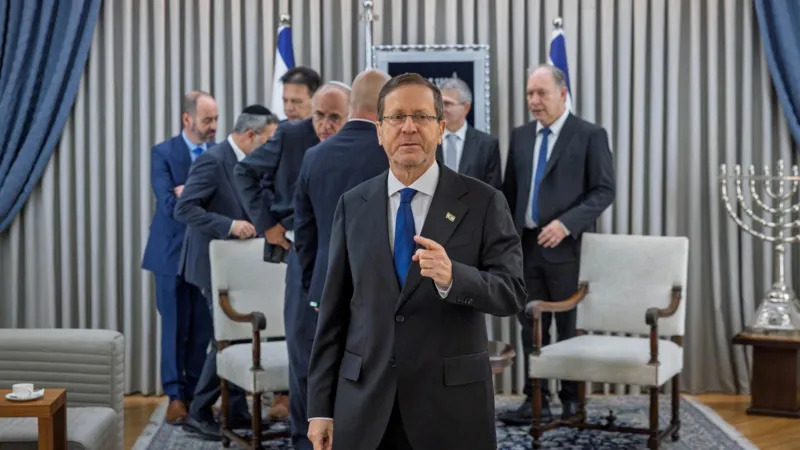
After receiving the official results of a general election last week, which he said had no obvious winner, Israeli President Isaac Herzog has started consulting with political groups about who should be in charge of building a new coalition government.
“Not every commitment and promise can be fulfilled” if party leaders wish to prevent another election, Herzog warned them.
Both Prime Minister Benjamin Netanyahu’s group and his opponent Gadi Eisenkot failed to win a majority in parliament.
| Israel Election: Quick Facts | |
|---|---|
| Election Date | 27 October |
| Location | Israel |
| Netanyahu's Bloc | 53 Seats |
| Opposition Bloc | 48 Seats |
| Arab Led Parties | 19 Seats |
| Total Knesset Seats | 120 |
| Majority Required | 61 Seats |
| President | Isaac Herzog |
| Security Agency | Shin Bet |
| Current Situation | Coalition negotiations |
Israel's Election Deadlock Deepens
Earlier, electoral officials stated that there was no proof of anomalies and that the unsupported allegations of Arab-dominated parties led by Netanyahu “stealing” the election did not warrant postponing the certification of the results.
The head of the Central Elections Committee emphasized that while the Shin Bet security organization is looking into claims of foreign meddling in the election, they would not significantly alter the result.
Following a spike in Arab voting turnout, two Arab-led coalitions, the United Arab List and the Joint List, collectively gained an unprecedented 19 seats.
Israel's Coalition Formation Challenge
Thus, they may be kingmakers. However, before to the elections, all but one of the Jewish parties pledged not to work with them to form a government.
After an election, the president of Israel is responsible for requesting a member of the Knesset to form a government, however their duties are primarily ceremonial. That worker will have 28 days to do the assignment, with a potential 14-day extension.
Anybody who the president believes has the highest chance of establishing a coalition may be chosen. It is not necessary to select the leader of the party with the most seats.
Herzog Begins Israel's Coalition Talks
At a ceremony in Jerusalem on Wednesday morning, Justice Noam Sohlberg, the chairman of the Central Elections Committee, gave Herzog the official results.We have heard voices in recent days attempting to question the validity of the election results. “This is a serious threat,” Sohlberg stated.
Herzog declared that he will start the consultation process on Wednesday nite.I anticipate that the factions and their representatives will recognize the existing reality in order to avoid another round of elections and to establish a stable and good administration here for the people of Israel.
Herzog Condemns Racism Against Arab Israelis
Additionally, the president urged patience and expressed trust in the Shin Bet’s capacity to look into the claims of foreign meddling in the election.
However, he cautioned that Arab Israelis “must not be smeared” because they comprise around one-fifth of the population and frequently identify as Palestinian citizens of Israel.
Sohlberg had earlier informed a Central Elections Committee meeting that intelligence from the Shin Bet seemed to indicate a “widespread phenomenon involving the influx of substantial funds into Israel from foreign states,” some of which were unfriendly.
Foreign Interference Allegations Spark Controversy
It stated that more research was necessary to “connect the dots and determine the scale of the phenomenon with a high degree of certainty.”
Israeli media revealed last week that the committee had received an accusation that Qatar had given money to boost Arab populations’ election turnout. The accusation was vehemently dismissed by Qatar’s foreign ministry.
The prime minister’s friend and leader of the Jewish Power party, far-right National Security Minister Itamar Ben-Gvir, urged the Shin Bet to detain and question all Arab party officials “until these suspicions are fully clarified”.