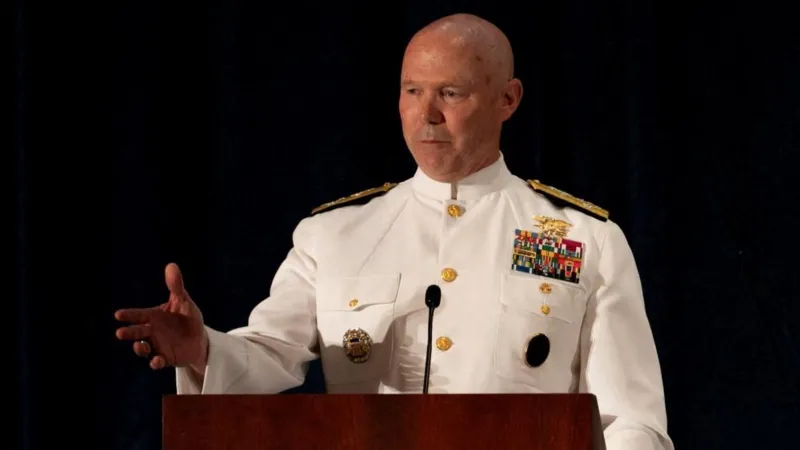
A senior US Navy admiral is under pressure in Washington after a controversial “double-tap” strike on a suspected drug-smuggling boat in the Caribbean. The September 2 operation has raised serious legal and ethical questions, and now lawmakers want answers.
Admiral Frank Bradley is giving private briefings to Congress, explaining why the Navy hit the vessel twice — a decision many experts believe may break international law.
The incident has also put the Trump administration’s aggressive anti-drug strategy under the spotlight. Critics argue the US may be using lethal force too quickly and without enough oversight.
Lawmakers Alarmed After Viewing Classified Video
On Thursday, members of the House Intelligence Committee watched classified video of the attack. One lawmaker called it “one of the most troubling things” he had ever seen.
Congressman Jim Himes said the boat carried drugs, but the first strike had already incapacitated the people onboard. He said they could no longer complete their mission after the initial hit.
Reports say two survivors tried to climb back onto the damaged boat — possibly to retrieve the remaining drugs — moments before the second strike.
White House Confirms — and Defends — the Second Strike
The White House first disputed parts of the story. Later, officials confirmed the second strike.
A spokesperson said Admiral Bradley acted “within his authority and the law.” President Trump added that he had “no problem” releasing the video of the second hit. Footage of the first strike is already public.
Bradley will brief the Senate next. He plans to show more video and explain why he believed the survivors still presented a threat.
A Deadly Pattern Raises New Concerns
The September 2 strike is not an isolated event. Since then, US operations across the Caribbean and Eastern Pacific have killed more than 80 people.
A Washington Post investigation earlier suggested that US forces were deliberately targeting survivors of initial strikes. Defence Secretary Pete Hegseth denied the report, calling it “fabricated.” The Pentagon also rejected the claim.
However, officials have now confirmed the second strike in this case.
Hegseth said he only watched footage of the first strike and did not know survivors remained alive afterward.
Experts Warn the Follow-Up Strike May Be Illegal
International law specialists told the BBC that the second strike may violate the Geneva Conventions.
They argue that if the survivors were injured, unarmed, or unable to fight, the US should have treated them as shipwrecked individuals — a protected group that cannot legally be targeted.
The Trump administration says these missions fall under a “non-international armed conflict,” which allows the military to treat suspected traffickers as enemy targets. But critics say the government has produced no public evidence proving the victims were traffickers.
Families Still Searching for Answers
One of the men killed was Alejandro Carranza, a Colombian national who disappeared on September 14. His family has filed a case with the Inter-American Court of Human Rights. They want to know what happened and who is responsible.
Admiral Bradley has not made any public comments. He is expected to testify again in upcoming closed-door hearings, alongside General Dan Caine, chairman of the Joint Chiefs of Staff.