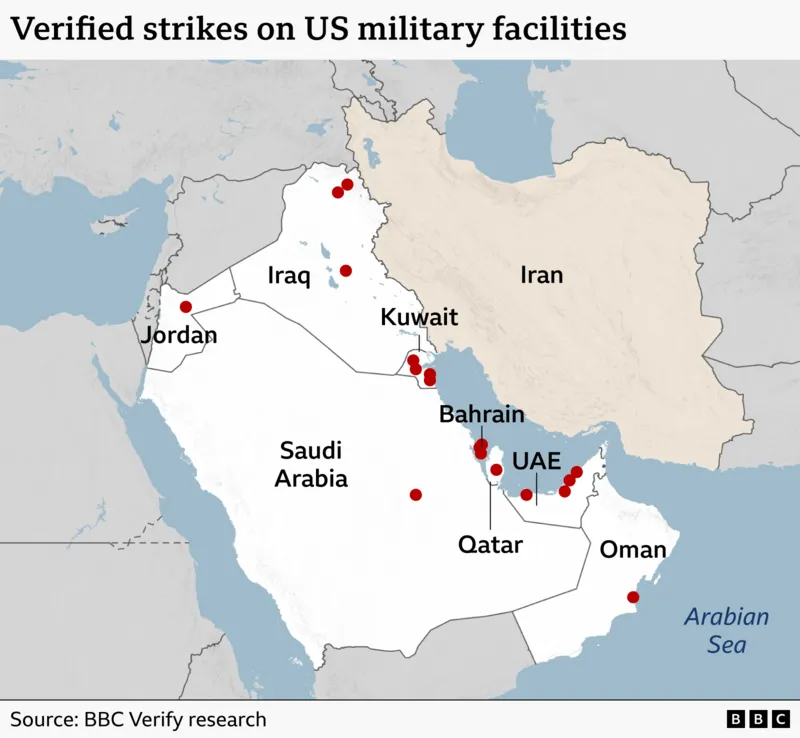
Recent satellite imagery has revealed extensive damage to US military facilities across the Middle East following a series of Iranian retaliatory attacks. The findings suggest that the impact of these strikes may be far greater than publicly acknowledged.
According to satellite analysis, Iran has damaged at least 20 US military sites since the conflict began. The attacks targeted key military facilities in eight Middle Eastern countries, including Saudi Arabia, the United Arab Emirates, Qatar, Kuwait, Iraq, Jordan, Bahrain, and Oman.
Iranian Strikes Hit Strategic Military Facilities
Iran launched the attacks in response to US and Israeli military operations carried out across Iran and Lebanon over the past several months. The strikes focused on both American military bases and shared defense facilities used by allied forces.
Military analysts say the attacks damaged important defense assets, including advanced radar systems, refueling aircraft, and missile defense equipment. The destruction could cost millions of dollars and affect military operations across the region.
Advanced THAAD Systems Among Damaged Equipment
Some of the most significant damage involved three Terminal High Altitude Area Defense (THAAD) missile batteries located at Al Ruwais and Al Sader airbases in the UAE and Muwaffaq Salti Airbase in Jordan.
The United States operates only a limited number of THAAD systems worldwide. Each battery costs approximately $1 billion to manufacture and requires around 100 personnel to operate. In addition, each interceptor missile carries a price tag of roughly $12.7 million.
Damage to these systems highlights the effectiveness of Iran’s targeting capabilities and raises concerns about the protection of strategic military assets in the region.
Questions Raised Over Scale of Conflict
While US officials have repeatedly stated that Iranian military capabilities have been significantly weakened, the latest satellite evidence paints a more complex picture. Security experts argue that the attacks demonstrate Iran’s ability to conduct precise strikes against high value military targets.
Some analysts believe the number of affected military sites could be even higher than current estimates. Several assessments suggest that as many as 28 facilities may have been hit during the ongoing conflict.
Satellite Restrictions Spark Transparency Concerns
The conflict has also created challenges for independent monitoring. A major satellite imagery provider recently restricted access to new images covering Iran and much of the Middle East. The company stated that the move was intended to prevent sensitive information from being used against allied military personnel and civilians.
Despite these restrictions, analysts continue to examine imagery from alternative international providers to assess the extent of the damage.
Growing Regional Security Concerns
The latest findings underline the growing risks facing military forces operating across the Middle East. As both sides continue to exchange attacks, concerns are increasing over the possibility of a wider regional confrontation.
The damage reported at multiple military installations demonstrates that the conflict is affecting strategic infrastructure on a significant scale. Analysts warn that continued escalation could further destabilize an already volatile region.