
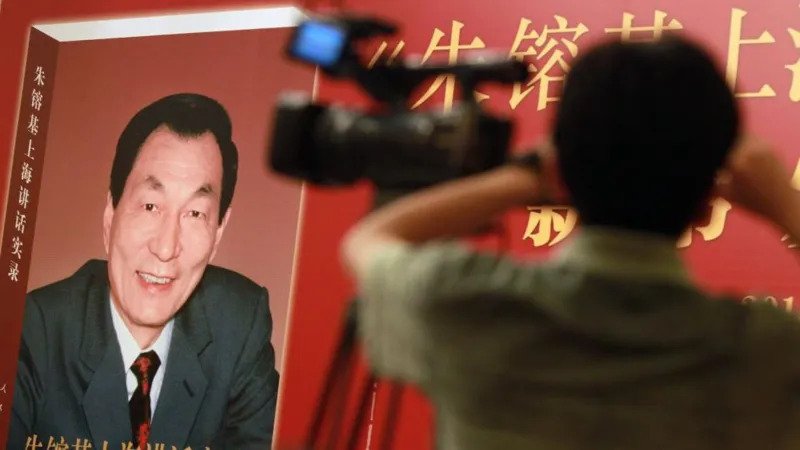
China has held a funeral for former Premier Zhu Rongji, one of the country’s most important economic reformers, who died last week at the age of 97. His body was cremated in Beijing on Tuesday, August 18, as national flags were lowered at government sites and security was tightened in parts of the capital.
President Xi Jinping and other senior Chinese leaders attended the ceremony at Babaoshan Revolutionary Cemetery. Zhu’s death has also triggered renewed discussion about the economic reform era he represented, a period when China expanded rapidly, opened further to global trade and joined the World Trade Organization.
China Holds Funeral for Zhu Rongji
Zhu Rongji’s funeral was held in Beijing on Tuesday, with China’s top leadership paying tribute to the former premier.
Xi Jinping and the other members of the Politburo Standing Committee stood in silence and made three bows before Zhu’s cremation, according to China’s official Xinhua news agency. Former President Hu Jintao also sent a wreath of condolence.
Security was tightened in Beijing, particularly around Tiananmen Square and Zhongnanhai, the central leadership compound. These areas were along the route to the cemetery where Zhu was cremated.
The official response was respectful but carefully controlled. Authorities have historically been cautious about large public gatherings following the deaths of prominent political figures because mourning can sometimes develop into wider political criticism.
Zhu served as China’s premier from 1998 to 2003 under President Jiang Zemin. Before becoming premier, he had already gained a reputation as a strong economic manager and reformer.
During his time in national leadership, Zhu pushed through major changes to China’s economy. His government restructured state owned companies, strengthened the tax and banking systems and worked to reduce inflation.
The reforms were difficult and came with a significant social cost. Large numbers of workers lost their jobs as unprofitable state companies were restructured. Supporters argued that these changes were necessary to make China’s economy more efficient and competitive.
Zhu also played a major role in China’s entry into the World Trade Organization in 2001. WTO membership helped deepen China’s integration with international markets and became an important milestone in the country’s economic transformation.
Why Zhu Rongji Was Known for His Direct Style
Zhu became known for speaking openly about difficult economic and political problems.
He was particularly recognised for his tough approach to corruption, inefficient state companies and government waste. His direct language sometimes made him stand out from the more formal style normally associated with senior Chinese officials.
At a 1999 news conference with former US President Bill Clinton, Zhu was asked about allegations that China had made political donations to Clinton’s Democratic Party.
“If the political contribution were to be really that effective, and I have $146 billion of foreign exchange reserve, I can put out at least $10 billion for that purpose. Why just $300,000? That would be too foolish,” Zhu said.
Zhu also emphasised practical results when discussing economic reform. In a documentary about former President Jiang Zemin, he was shown explaining his approach to difficult decisions.
“I’m not here to talk about pros and cons. I am here to talk about how to get things done.”
Zhu Rongji and Jiang Zemin
Zhu’s political career was closely connected with Jiang Zemin, who led China during much of the same period.
Jiang became Communist Party leader in 1989 and president in 1993. Zhu became premier in 1998, and the two worked together during a period of rapid economic expansion and deeper international integration.
Their leadership period included major economic restructuring and China’s move into the WTO. Zhu’s reforms helped create the conditions for stronger participation in global trade, while also forcing many state owned companies and workers to adjust to a more competitive economy.
Jiang died in 2022. Zhu’s death has now brought renewed attention to the leaders and policies associated with that period.
Public Nostalgia for the Reform Era
Zhu’s death has prompted discussion online about what his period in government represented.
Some Chinese commentators have expressed nostalgia for the 1990s and early 2000s, remembering a time when economic growth was rapid and the country was opening further to the outside world.
Economist Zhao Jian wrote about that period as a time when people were “properly poor” but had greater confidence about the future.
“There were no smartphones then, no short form videos and no screens filled by the purveyors of anxiety,” he wrote.
“The sky was blue, life moved slowly and people could say what they really thought.”
According to the supplied source material, Zhao’s essay was later removed from WeChat. This specific claim should be checked against the original post before publication.
Public reactions have not been entirely positive. Zhu’s economic reforms caused major disruption, particularly for workers affected by state owned enterprise restructuring. Some people therefore remember him as responsible for painful economic changes, while others credit him with helping modernise China’s economy.
Why Zhu's Death Is Politically Sensitive
The Chinese government has historically been cautious about public reactions to the deaths of senior political figures.
The deaths of former Premier Zhou Enlai in 1976 and former Communist Party leader Hu Yaobang in 1989 were followed by major public gatherings. The mourning after Hu’s death eventually became connected with the pro democracy demonstrations of 1989.
That history helps explain why public discussion surrounding former leaders can be closely monitored.
Reports following Zhu’s death indicate that some online posts about his legacy were removed. At the same time, official Chinese media has presented Zhu as a loyal Communist Party member and an important national leader.
China's Economy Has Changed Since Zhu's Era
Zhu’s death comes as China faces economic challenges that are very different from those of the late 1990s.
Growth has slowed from the exceptionally high rates seen during China’s earlier transformation. The country is also dealing with weakness in its property sector, demographic pressures and high youth unemployment.
Under Xi Jinping, China’s economic strategy has placed greater emphasis on state direction, technological independence and strategic industries.
This differs in important ways from the period associated with Zhu and Jiang, when market reforms, private business and international trade were central to China’s economic expansion.
For some Chinese people, the memory of Zhu’s era is therefore connected not only with economic hardship but also with the belief that hard work could lead to improving living standards.
Xi Jinping's Historical Narrative
Zhu Rongji’s death is unlikely to produce an immediate change in China’s economic or political policies.
His legacy will instead remain part of discussions about China’s reform period, its transition toward a more market based economy and its eventual integration into global trade.
The government is expected to continue presenting Zhu’s career as part of the Communist Party’s broader history, while public comparisons between his era and the present political system may remain sensitive.
Conclusion
Zhu Rongji’s death has brought renewed attention to the economic reforms that helped transform China during the 1990s and early 2000s.
His funeral also highlights the complicated legacy of a leader remembered both for the economic disruption caused by his reforms and for helping China become more deeply connected to the global economy.