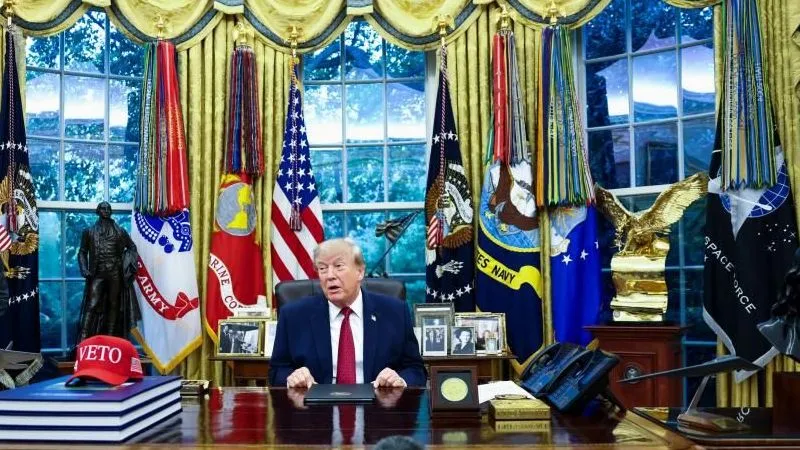
Donald Trump, the president of the United States, has issued an executive order that he claims would stop future presidents from altering the White House Oval Office.
The president’s refurbished official office is designated as a national monument by the presidential decree.Trump told reporters on Thursday, “We’re making it a national monument, and it won’t be allowed to be touched by anybody, destroyed, or torn down by stupid people in order to build something in a slightly different shape.”
Quick Fact
| Detail | Information |
|---|---|
| What Happened | Trump designated the Oval Office as a national monument. |
| Location | White House, Washington, DC, USA |
| Date | November 5, 2026 |
| President | Donald Trump |
| Rooms Covered | Oval Office, Outer Oval Office and Cabinet Room |
| Managing Agency | National Park Service |
| Key Purpose | To protect the historic structure and architectural character of the rooms. |
| Current Status | Presidential proclamation signed. |
Presidential Authority Over White House Renovations
Future presidents are free to alter the iconic room’s décor notwithstanding the order.
The agreement notes that it does not “restrict the President’s authority to redecorate the monument, select furnishings, or make ordinary operational and security modifications that do not substantially impair the monument’s historic structure or architectural character”.
Presidents of the United States now have the authority to make basic alterations to the White House, but major initiatives need congressional approval.
The directive was issued months after Trump demolished the White House East Wing in a project that has been challenged in court.
Trump Defends White House Renovations
“We like the Oval Office, and it’s a symbol, like the White House itself,” the president stated when signing the new executive order on Thursday. It is a representation of our nation and its magnificence.
“World leaders who have visited in recent months have praised his decorative changes to the room,” he continued.
Trump described the White House and the Oval Office as “badly damaged” and stated that they needed repairs. He spoke of fractured walls, broken stone, and broken windows.
However, a massive gold plate outside that stated “Oval Office” was one of the many obvious alterations that were purely cosmetic.
Legal Uncertainty Over Oval Office Changes
It’s unknown if a future president could simply undo this decision or if there would be a legal challenge.
The majority of executive orders are reversible, and in 2017, Trump personally reduced the size of two national monuments in Utah. However, the revocation of a national monument designation has not yet been put to the test in court.
The White House grounds have already been classified as a National Historic Landmark, which is meant to guard against abrupt alterations to the structure.
According to Trump’s directive, the National Park Service must preserve the Oval Office “in a manner that protects its historic character, architectural integrity, and association with the Presidency.”
Presidents Retain Control Over Oval Office Decor
To enable presidents to make necessary adjustments, Congress has created an exception to the National Historic Preservation Act. President Franklin D. Roosevelt created the current Oval Office, which has been in existence since the early 1930s.
According to Greg Werkheiser of the historic preservation-focused legal firm Cultural Heritage Partners, “furniture and decor is completely up to the president’s discretion” when it comes to temporary changes.They may usually do everything they want, he told the press, as long as they don’t harm the permanent art and architecture.
Trump Faces Historic Preservation Criticism
Werkheiser contends that the Trump administration has disregarded other Washington historic monuments and has tried to weaken the rules requiring preservation through legal actions.
He referred to Trump’s order as “hypocrisy” and mentioned the several initiatives he has campaigned for around Washington, such as the construction of a new triumphal arch, which a federal judge has temporarily halted.
On the one hand, he is discussing the significance of maintaining the Oval Office, which has no legal significance because he is unable to do so; on the other side, he is blatantly stealing.