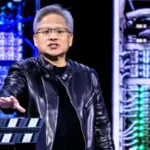
The footage of the powerful billionaire eating noodles and sipping milk tea on a visit in May surfaced online, he expressed his love for China. The majority of netizens are happy to have him again. Some questioned why he wasn’t wearing one of his leather coats in the footage of him making his way back to Nvidia’s headquarters.
Quick Facts
| Detail | Information |
|---|---|
| What happened | Jensen Huang returned as Nvidia CEO amid ongoing spy probes, while the US tightened chip export rules. |
| Where | Washington, D.C., Shenzhen, and global tech hubs (Singapore, Malaysia, Thailand). |
| When | November 2026, following an October Nvidia event in Berlin and a recent Shenzhen summit. |
| Who is involved | Jensen Huang, Donald Trump, Xi Jinping, US lawmakers, and Nvidia. |
| Current status | Huang is back at Nvidia, federal investigations remain active, and new US export controls are rolling out. |
| Why it matters | The dispute threatens global supply chains, US equity markets, and critical tech and mineral trade. |
Xi Jinping most likely feels the same way.
Beijing has denied allegations that one of the women who had an affair with Jensen Huang was hired as a spy by China’s Ministry of State Security, which is the country’s equivalent of the CIA. The espionage scandal has also been presented by Chinese state media as a slander campaign by Washington-based China hawks. It was called a “witch hunt” by the Communist Party organ, The Global Times.
Huang is not a threat to national security, according to the White House and President Donald Trump, even if the espionage claims are still being investigated.
Xi Reads Trump’s Pressure Points
This incident will have taught Xi a lot, particularly about Trump’s pressure points.
One indication that direct interaction is a successful strategy for influencing Washington is the fact that Huang’s reappointment occurred so soon after Xi and Trump met in Shenzhen last week.
The incident has also strengthened the perception among Chinese officials that there are two groups in Washington: those who support limiting Chinese access to cutting-edge technology in order to safeguard US national security and those, like Huang, who think that such limitations won’t stop Beijing’s aspirations.
US Tightens China Chip Controls
The sale of cutting-edge chips will continue to be a major point of contention between the US and China, especially as the two sides attempt to reach a trade agreement before another Trump-Xi meeting, which is expected in December.
New regulations are already being put in place that will worry Beijing.
Huang has repeatedly argued that US export controls will force Chinese companies like Huawei to build independent alternatives—all the while shutting American companies out of the world’s second-largest economy.
Trump's Nvidia Stake Complicates Politics
The actions are intended to seal any gaps that would provide Chinese businesses access to cutting-edge Nvidia and AMD processors via cloud service providers in third-party nations like Singapore, Malaysia, and Thailand.
China has not yet taken any action in response. However, investors will be keeping a keen eye out for any escalation that can have an impact on US equities markets.
He now understands that Trump is willing to meddle with the HR choices of the largest corporation in the world because he is so concerned about the stock market.
Lawmakers Demand Answers Ahead of Huang Testimony
China has already forced the United States to engage in trade negotiations by using its significant control over the world’s rare earth metals.
Because American businesses, including automakers, defense corporations, and chip manufacturers, depend on rare earths, a cycle that might have a significant impact on the stock market could begin if Washington curbs chip exports and Beijing retaliates.
As it attempts to establish what it refers to as a “constructive strategic relationship” with the US, China has realized that additional difficulties are in store.