
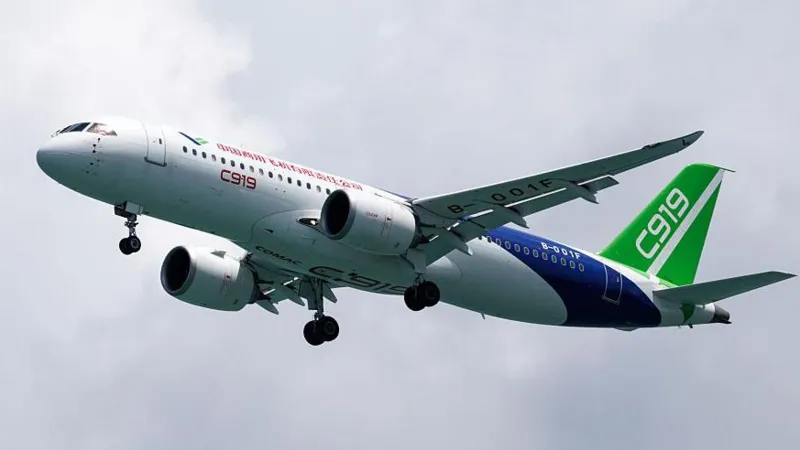
Comac Steps Into the Global Spotlight
At the Singapore Airshow, aviation companies from around the world are showing off their latest aircraft designs and technology. Among the biggest attractions this year is Comac, China’s state owned aircraft manufacturer.
Comac gained attention after its C919 passenger jet arrived in Singapore. This marked the aircraft’s first flight outside China. The company designed the C919 to compete directly with the Airbus A320neo and Boeing 737 MAX.
Now, Comac is openly aiming to expand beyond China. The company says it is focusing on the Southeast Asian aviation market, where demand for new aircraft is rising fast.
Asia Pacific Airlines Need More Aircraft Options
Asia Pacific is the fastest growing aviation market in the world. Airlines in the region are struggling to get new planes due to long delivery delays from Boeing and Airbus.
Supply chain problems and a global engine shortage have made things worse. Trade tensions and tariff uncertainty have also slowed aircraft production.
According to IATA, airlines are waiting longer than ever for new planes. This has increased the average age of aircraft fleets. Older planes burn more fuel and cost more to operate.
Willie Walsh, head of IATA, believes Comac could become a global competitor. He said that within ten to fifteen years, Comac may stand alongside Boeing and Airbus as a major player.
Why Airlines Are Turning to Comac
Comac says it has delivered over 200 C909 and C919 aircraft so far. Airlines in Laos, Indonesia, and Vietnam are already flying these jets. Brunei’s GallopAir has placed a large order, and Cambodia plans to buy around 20 aircraft.
Industry leaders say the region needs more aircraft manufacturers. Many believe the market has relied too long on just two suppliers.
Lower prices and strong government support make Comac attractive, especially for budget airlines in developing markets.
Certification and Infrastructure Remain Challenges
Comac is also working toward European certification for the C919. Regulators have already started test flights. Approval could allow the aircraft to enter European markets.
However, the process may take several years. Experts say certification could happen between 2028 and 2031.
Comac also needs to build maintenance networks, pilot training systems, and repair facilities. Boeing and Airbus have spent decades developing these services worldwide.
Competition Is Still Strong
Comac is not the only alternative in Asia Pacific. Brazil’s Embraer already supplies aircraft to airlines such as Scoot, Virgin Australia, and ANA.
Boeing and Airbus also remain dominant. Both companies say aircraft delivery schedules are slowly improving, which could ease airline concerns.
There are also questions about Comac’s order numbers. While the company claims more than 1,000 C919 orders, only a small number have reached airlines so far. Since Comac is not publicly listed, verifying these figures is difficult.
Unless Comac solves certification, delivery, and infrastructure issues, Boeing and Airbus are likely to remain the top aircraft suppliers in the region.