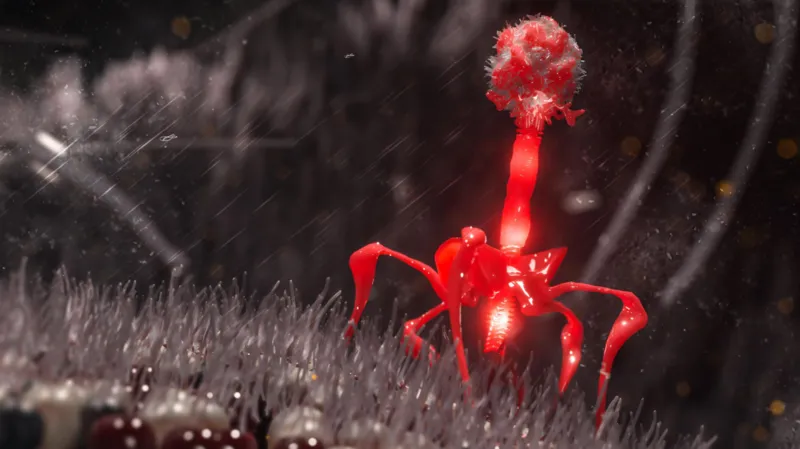
AI Creates Brand New Viruses
According to US researchers, artificial intelligence has been used to create whole new viruses that can proliferate in a lab.
AI has successfully created whole genomes for the first time.
The 16 new viruses that resulted were designed to infect bacteria without endangering humans.
The discovery has been described as a “very significant turning point” in research that may usher in a new age of medical treatment. However, researchers have cautioned that viruses created by AI pose “urgent” security and safety risks.
AI technologies are developing quickly and have already been applied to the creation of novel antibiotics.
But,compared to creating a brand-new, functional virus from start, it is rather easy.
AI Designs Complete Virus Genome
According to Brian Hie, an assistant professor at Stanford University, “This is a next step in the complexity that can be designed by generative AI. This is the first time generative AI has been used to design a complete genome.
It’s something that can replicate and have other functions inside cells. This was new territory for us.”
The technique functions similarly to huge language models that anticipate text sequences, such as ChatGPT.
In this case, the Evo1 and Evo2 AI models anticipate the language of life instead of words.
The genetic codes of bacteria, viruses, plants, and humans were used to train the AI models.
After then, they were improved to create a particular kind of virus called a bacteriophage, which only infects particular bacterial species.
They found the phage were active in the early hours of the morning, according to Samuel King, a PhD candidate at the lab.
After placing the phage on petri dishes with a layer of bacteria growing on them, the scientists looked for signs that their new viruses were having fun.
We were starting to see these different places, so it was incredibly exciting,” King says.
Computers Enter New Biology Era
From atoms to computer bits
Since viruses are not living things, artificial intelligence would need to advance much before it could produce life things.
The phage’s genetic code consists of around 5,400 base pairs, or letters. A live cell’s genome can be as little as 500,000 base pairs. Three billion base pairs make up the human genome.
They were “definitely interested in working towards” that, according to Hie. “It would probably be a lot of work, but not impossible” to try some basic organisms.
The discovery was a “very significant turning point” because, for the “first time in history, we are beginning to design biology on a computer,” according to Prof. Marc Güell of the synthetic biology lab at Pompeu Fabra University in Spain.
AI Boosts Future Medical Innovation
He said that it “allows us to dream of exciting possibilities for tackling humanity’s greatest challenges” including creating antibodies that might be used in immunotherapy. The phages to combat illness, and enzymes to cure genetic diseases.
The work is a “significant milestone,” according to Prof. Patrick Cai, head of synthetic genomics at the Manchester Institute of Biotechnology.
The relevance goes well beyond phages; it implies that genome language models are starting to pick up the design principles that evolution has encoded, paving the way for AI-assisted genome composition.