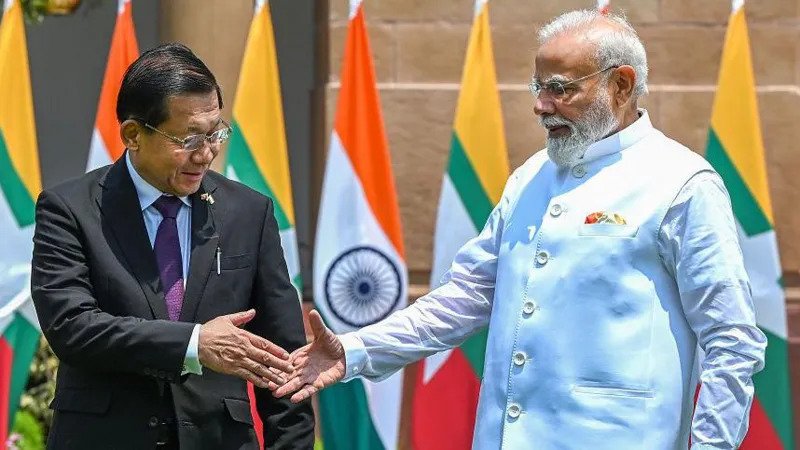
Myanmar president Min Aung Hlaing is on a five day visit to India, where he met Prime Minister Narendra Modi in New Delhi. Their discussions focused on trade, connectivity, border security, and defence cooperation. The visit has drawn strong attention due to Myanmar’s ongoing political crisis and its impact on regional stability.
First Foreign Visit After Taking Office
This marks Min Aung Hlaing’s first international trip since becoming president earlier this year. His leadership followed a controversial election held after years of conflict and political unrest in Myanmar.
Between the 2021 military takeover and his presidency, he previously visited China and Russia. However, this India trip is his first official overseas engagement in his current role.
Background of Myanmar Political Crisis
Myanmar has remained in crisis since February 2021, when the military removed the elected government led by Aung San Suu Kyi. The takeover triggered nationwide protests that later turned into armed resistance.
The situation developed into a long civil conflict. Thousands of people have died, and millions have been displaced. Large parts of the country are no longer under central control.
Impact on India Myanmar Border
India shares a long border with Myanmar that stretches over 1,600 kilometres. The conflict has directly affected India’s northeastern region, especially in states like Mizoram and Manipur.
Many people from Myanmar, particularly from ethnic minority groups, crossed into India to seek safety. The movement of people, along with security concerns and cross border trade issues, has made the situation important for India’s internal stability.
Talks Between Modi and Min Aung Hlaing
During the meeting, both leaders discussed regional security and development cooperation. Indian officials stated that Prime Minister Modi also raised concerns about the political situation in Myanmar and emphasized the importance of inclusive dialogue.
India expressed support for long term peace and encouraged engagement between all political groups in Myanmar. Officials highlighted that continued dialogue could offer a path toward stability.
Controversial Election and Global Reaction
Myanmar held elections between late 2025 and early 2026. The military backed political side won a large majority. However, many opposition groups were not allowed to participate, and several conflict affected regions could not vote.
Authorities described the election as a step toward civilian governance. In contrast, critics and international observers questioned its fairness and argued that military influence remained strong.
Regional and Strategic Importance
Myanmar’s location makes it strategically important for India and other regional powers. It sits at the crossroads of South and Southeast Asia, influencing trade routes, security cooperation, and migration patterns.
India continues to balance its diplomatic engagement with concerns about democracy, stability, and border security.