
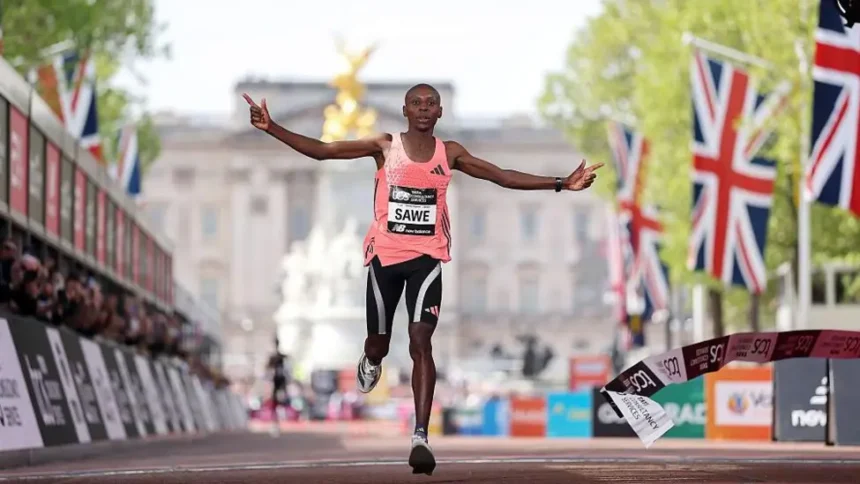
Sebastian Sawe delivered a landmark performance by breaking the sub-two-hour marathon barrier in London. What makes this achievement stand out is the context behind it. Sawe entered the race after dealing with a stress fracture following the Berlin Marathon. On top of that, a back issue in January nearly forced him to stop training. He only resumed proper preparation in early February, which makes his performance even more impressive.
A Record on a Challenging Course
London is not known as the fastest marathon course. Races in Berlin and Chicago usually produce quicker times due to flatter layouts and fewer turns. In contrast, London’s route presents more challenges. It has not seen a men’s marathon world record since 2002. Despite that, Sawe managed to deliver a historic run, proving that conditions are no longer the main limit in elite marathon racing.
From Controlled Conditions to Open Competition
Back in 2019, Eliud Kipchoge became the first athlete to complete a marathon in under two hours. However, that run took place under controlled conditions. The course had minimal elevation, and the attempt was not eligible for official records. Sawe’s performance in London stands apart because he achieved it in a competitive race environment, making it officially recognized and far more significant.
More Athletes Break the Barrier
The race did not belong to Sawe alone. Yomif Kejelcha, running his marathon debut, also finished under two hours. Meanwhile, Jacob Kiplimo, known for his half marathon world record, delivered a remarkable performance by beating the previous marathon record set by Kelvin Kiptum. These results show a clear shift in the sport, where multiple runners now compete at a level once thought impossible.
A Defining Moment for Marathon History
Kipchoge reacted to the race by calling it a historic day for marathon running. He highlighted how two athletes breaking the sub-two barrier in a major race signals a new era. According to him, this moment reflects the power of talent, progress, and belief in human potential.
Sawe’s run in London has redefined what athletes can achieve in marathon racing. It also shows that breakthroughs are no longer rare events. Instead, they are becoming part of a growing trend in long-distance running.