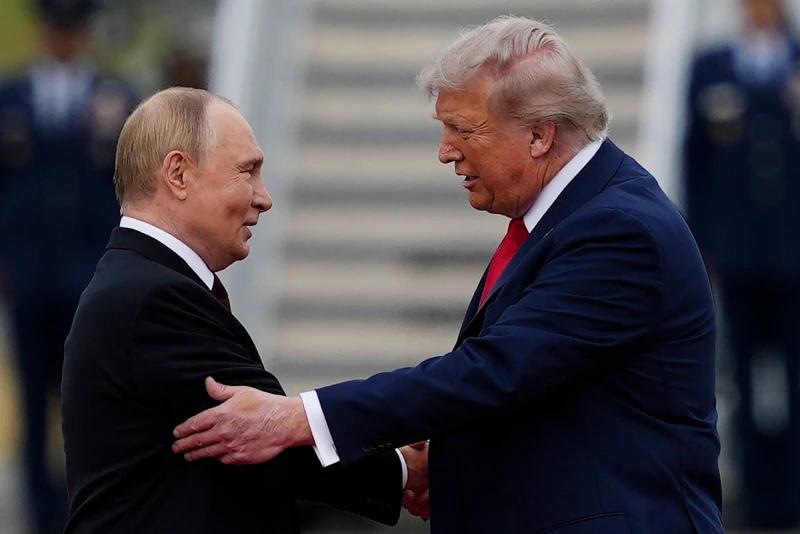
During Donald Trump’s first term in office, the speaker of the House stepped in front of him and said, “With this president, all roads lead to Putin.”
Following Trump’s unexpected announcement last week that he had reached an agreement with Russian President Vladimir Putin to import tons of Russian diesel to the United States in order to reduce exorbitant gas prices for Americans ahead of the midterm elections, Nancy Pelosi’s harsh assessment from years ago was echoed once more.
Quick Fact
| Detail | Information |
|---|---|
| What Happened | Trump announced a diesel deal with Russia. |
| Countries Involved | United States and Russia |
| Key Leaders | Donald Trump and Vladimir Putin |
| Main Issue | Russian diesel shipments and sanctions relief |
| Criticism | Lawmakers raised concerns about sanctions enforcement and Russian war funding. |
| Why It Matters | The deal could affect fuel prices, Russia’s energy revenue and support for Ukraine. |
Both Republicans and Democrats have attacked Trump’s diesel agreement with Putin, claiming that it violates current U.S. regulations, fuels Russia’s conflict against Ukraine, and brings the United States closer to Russia.
It adds to an increasing number of cases when the Republican president has sided with Putin, frequently at the price of Ukraine and the reputation of the United States.
William Taylor, a former American ambassador to Ukraine and current senior fellow at the Atlantic Council, stated in an interview on Monday that “the harm to the Ukrainians is real.”
"And it comes at a high cost to the United States."
The Trump-Putin agreement may or may not provide the supply increase the president wants to lower costs. According to energy analysts, the flow of Russian diesel is unlikely to bring down U.S. prices, which have risen owing in large part to interruptions caused by the U.S. war against Iran. However, as Ukraine fights Russia, the deal emphasizes a message both domestically and internationally that Trump is an untrustworthy friend.
Over the weekend, a bipartisan group of six senators called on Trump to change direction, stating that the United States “should not provide Putin with a financial lifeline.”
Trump Defends Controversial Russia Energy Deal
Trump declared on Monday outside the White House, “I like anything that could help our farmers, our ranchers.”
Zelenskyy said that Moscow was still attacking his nation’s energy facilities, while Trump assured that an energy truce between Russia and Ukraine was in effect.
According to a survey released on October 1 by the NORC Center for Public Affairs Research, Americans are unhappy with Trump’s handling of the Iran conflict and hold him responsible for price increases.
Congress voted to halt Russian imports, but Trump has other plans
At the beginning of the Russian invasion of Ukraine in the spring of 2022, Congress quickly passed laws prohibiting the import of Russian energy goods, which are generally believed to be the source of funding for Putin’s military attack on Ukraine.
The law was overwhelmingly approved by the House (414–17), and there was not a single senator who opposed it in the Senate. According to the legislation, if a deal is achieved to remove Russian forces from Ukraine and stop military operations, the president may try to suspend the ban. Congress would need to evaluate and consider such a plan.
Trump’s Russia Deal Raises Sanctions Concerns
Trump, he claimed, “illegally rewards his pal Putin while once again blaming Zelensky for not capitulating to Putin.”
More recently, a comprehensive Russian sanctions package named for the late GOP Senator Lindsey Graham was adopted by Congress last month. It will impose taxes on nations that still purchase Russian oil. The measure was signed into law by Trump.
After the administration’s 30-day review period ends on October 18, the majority of the law’s provisions take effect. However, since Trump’s diesel agreement with Putin would permit the flow of Russian energy, such action now seems to be in doubt.
Bipartisan Leaders Urge Action on Russian Oil Sanctions
Senate leaders from both parties stated last week in a letter to Secretary of State Marco Rubio and Treasury Secretary Scott Bessent that addressing the “shadow fleet” of tankers Moscow is exploiting to move oil and get around US sanctions must be the United States’ top concern.
A request for comment on Monday was not immediately answered by Treasury.
“It makes me a little bit nervous every time we’re talking,” said Republican Representative Ashley Hinson, who is running against Democrat Josh Turek for the U.S. Senate in Iowa, where $6 a gallon diesel costs have become a problem.