
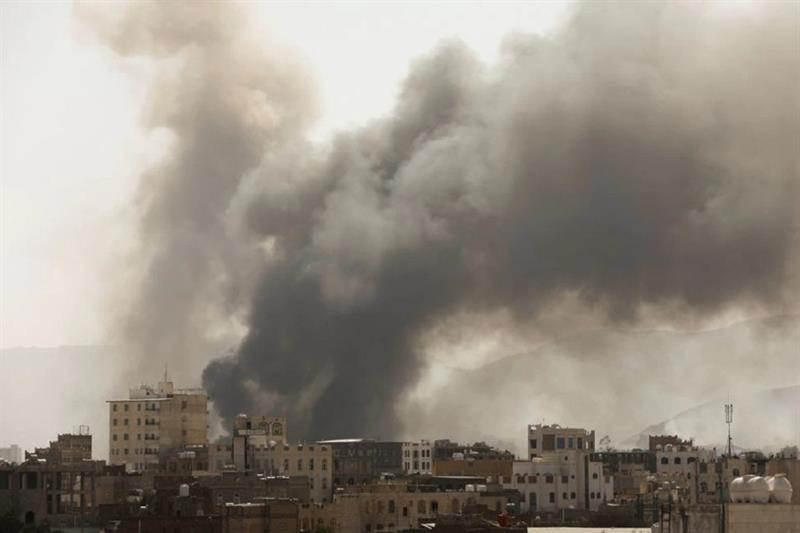
After demolishing tunnels used to store ballistic missiles and missile launchers, the Saudi-led coalition fighting the Houthi rebels in Yemen announced on Monday that it had reduced their capacity to attack targets inside the country.
The Israeli defense minister vehemently rejected that Prime Minister Benjamin Netanyahu’s purported orders for a “action” against Iran before of Tuesday’s national elections have caused a rift between the military and the government.
Quick Fact
| Detail | Information |
|---|---|
| Main Topic | Middle East Tensions |
| Key Locations | Yemen, Israel, Iran, Saudi Arabia, Egypt and the West Bank |
| Yemen Conflict | The Saudi led coalition reported destroying Houthi missile facilities. |
| Israel and Iran | Israel's defence minister denied reports of a dispute over possible action against Iran. |
| West Bank | The UN secretary general expressed concern over settler violence and settlement expansion. |
| Egypt and Saudi Arabia | Egypt's parliament approved support for Saudi Arabia amid security concerns. |
| Regional Impact | Developments could affect regional security, civilians and Red Sea shipping. |
| Verification Status | Some military claims require independent confirmation. |
Saudi-led coalition says it destroyed Houthi missile launchers
Five ballistic missile storage tunnels, four ballistic missile launchers, and another missile storage facility were destroyed during an operation in Houthi-controlled Yemen, according to a spokesman for the Saudi-led coalition fighting the Iran-backed Houthis.
In a post on X, spokesperson Maj. Gen. Turki al-Malki stated that the operation also targeted military assets and rebel fortifications along Yemen’s front lines and sought to sever the Houthis’ supply routes between regions under their control.
Explosions heard in Yemen’s capital and on its Red Sea coast
On Monday, there were explosions in Sanaa, the capital of Houthi-held Yemen, as well as along the Red Sea coast. Houthi-run media claimed that a water well and solar power system in the Sanaa area were struck by airstrikes, although they offered no proof.
At least four explosions were heard by residents in western Sanaa, though it wasn’t immediately apparent what had been struck. A woman who lives close to a Houthi base reported that windows in her house and other homes nearby were broken by a loud explosion. Fearing retaliation, she talked to The Associated Press on the condition of anonymity.
In the provinces of Aden and Lahj, the Houthi rebels said on Monday that they attacked military bases and weapons storage facilities owned by government troops supported by Saudi Arabia.
According to a statement from Houthi military spokesperson Yahya Saree, the rebels caused casualties by firing ballistic missiles at the locations. There was no way to independently confirm the statements.
The Houthis are still attacking Yemeni government troops and their supporters. Late on Sunday, the Yemeni government accused the rebels of attacking camps for displaced people on the outskirts of Aden, a port city in the south. The administration offered no proof to support this assertion.
Israel’s defense minister denies clash with the army over Iran
On Monday, Israeli Defense Minister Israel Katz said rumors that the Israeli military and political leadership are at odds over Iran “completely baseless and false.”
Katz said in a post on X that although Israel has no plans to attack Iran prior to Tuesday’s national elections, it would retaliate “with great force” if Iran launched an initial attack.
Netanyahu and Israel’s military chief of staff fought over the Israeli prime minister’s order to carry out a “action” that the army fears might swiftly rekindle the confrontation with Iran, according to an Israeli Channel 12 broadcast on Sunday nite.
Guterres expresses concern over Israeli settler violence
On Monday, U.N. Secretary-General António Guterres expressed his “deep alarms” at the rise in Israeli settler violence and settlement growth in the West Bank.
Speaking in Cairo on one of his last visits as head of the United Nations, Guterres stated that “the specter of ethnic cleansing looming ever larger” calls for the lifting of Israeli restrictions on humanitarian supplies to Gaza and the removal of barriers to the Security Council’s peace plan.
He said that Palestinians’ right to self-determination is essential to long-term peace in the area and that the only practical course of action is a two-state solution with Jerusalem serving as both states’ capital.
Egypt’s parliament approves help to Saudi Arabia
Egyptian lawmakers on Monday approved President Abdel-Fattah el-Sissi’s request for aid to Saudi Arabia to help the nation repel Houthi attacks.
The decision was taken in reaction to growing public concern over Egypt’s possible role in the lengthy Yemeni conflict.
The top security body in Egypt had earlier pledged to provide “all necessary and possible forms of support” to safeguard Saudi Arabia’s “security and stability,” maintain its resources and territorial integrity, and safeguard Islamic holy sites.