
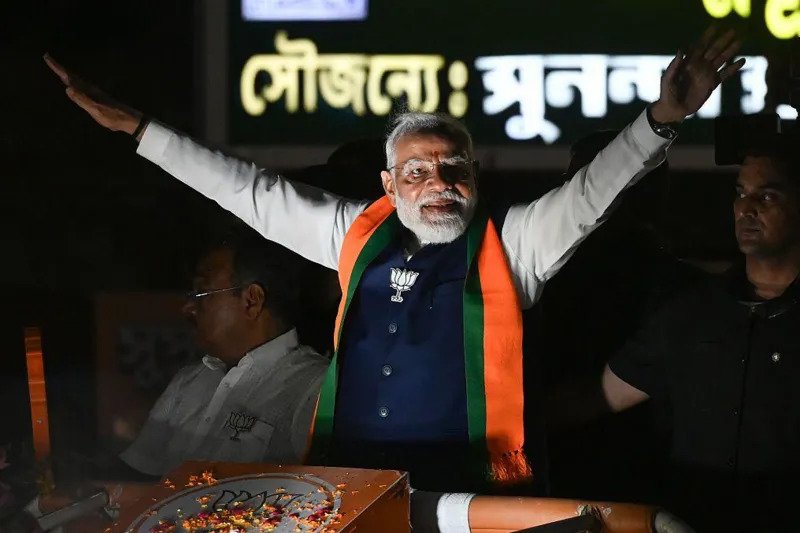
Narendra Modi has secured one of his most significant political victories as the Bharatiya Janata Party (BJP) wins West Bengal, a state that had resisted the party for years.
This result marks a major shift in Indian politics. West Bengal, home to over 100 million people, plays a crucial role in national elections. Winning here is comparable to securing power in a mid-sized country.
A Long-Standing Political Stronghold Falls
For decades, West Bengal followed a predictable political pattern. The Communist Left Front ruled for 34 years. After that, the Trinamool Congress (TMC), led by Mamata Banerjee, dominated the state for 15 years.
This long period of stable rule made Bengal one of the toughest regions for the BJP to penetrate. The state is known for strong political loyalty and a deep sense of cultural identity.
BJP’s Steady Rise, Not a Sudden Surge
The BJP’s victory did not happen overnight. The party has steadily built its presence in the state over the past decade.
Political analyst Rahul Verma notes that the BJP consistently secured around 39 to 40 percent of the vote in previous elections. This time, the party crossed 44 percent, which pushed it past the winning line.
This gradual growth shows a calculated and sustained strategy rather than a sudden wave.
A Turning Point for Eastern India
Winning West Bengal completes the BJP’s expansion into eastern India. The party had already made gains in regions like Assam and Tripura, but Bengal remained the biggest challenge.
Analysts describe this victory as the final step in the BJP’s broader national push. It signals stronger political control across diverse regions of the country.
Political Upsets Across Southern India
The election results also brought major changes in southern India.
In Tamil Nadu, M. K. Stalin’s DMK government lost power to actor-turned-politician Vijay and his new party, TVK. This marks a return of film-based politics in the state.
In Kerala, the Congress-led United Democratic Front defeated the Left Democratic Front. This ended the last Communist-led government in India.
Meanwhile, the BJP retained control in Assam and continued its hold over Puducherry.
Why Bengal Matters So Much
Among all these results, West Bengal stands out as the most politically important.
The state rarely changes leadership. Experts often describe its system as favoring dominant parties that stay in power for long periods.
Breaking this pattern is a major achievement for the BJP. It shows that even the most resistant political regions can shift with time and strategy.