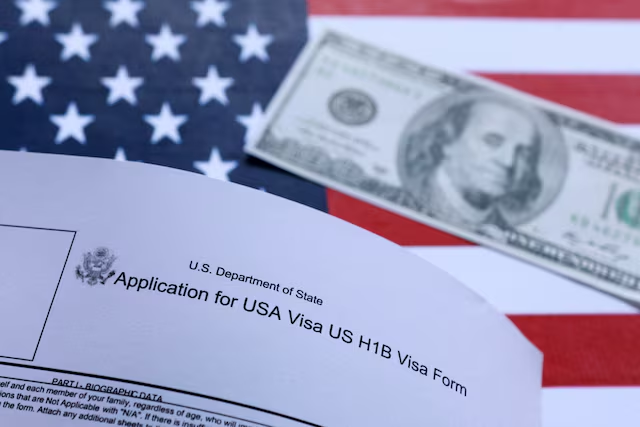
The Trump administration has proposed making a $103,265 fee for certain new H 1B visas permanent. The U.S. Department of Homeland Security published the proposal on Monday.
The plan would keep a major cost increase for companies that want to hire highly skilled foreign workers. However, the fee remains tied to ongoing legal challenges in U.S. courts.
Quick Facts
| Detail | Information |
|---|---|
| What happened | The administration proposed a permanent $103,265 H 1B visa fee. |
| Proposed fee | $103,265 |
| Visa program | H 1B specialty occupation visas |
| Annual visas | 65,000 regular visas plus 20,000 for advanced degree holders |
| Previous typical fees | About $2,000 to $5,000 |
| Main sectors affected | Technology, education and research |
| Current legal status | Courts have blocked collection of the temporary fee |
| Proposed timeline | The rule could become final by the end of 2026. |
Proposed $103,265 H 1B Fee
The proposed rule would turn the temporary H 1B fee into a permanent charge. Trump introduced the temporary fee last year, but a federal judge ruled in June that the administration could not legally collect it.
The case remains under review. A Boston based appeals court is considering the decision, while another court is examining a separate legal challenge.
The temporary fee is scheduled to expire in September. The new proposal could replace it if the administration completes the rulemaking process.
Who Could Face the New Fee?
The H 1B program allows U.S. companies to employ foreign professionals in specialized fields. These workers often have training in areas such as technology, science, engineering and research.
The program provides 65,000 visas each year. Another 20,000 visas go to workers with qualifying advanced degrees.
Before the Trump administration introduced the $100,000 level fee, companies generally paid much lower visa-related charges. The source reported that typical fees ranged from about $2,000 to $5,000.
The proposed fee would not cover every H 1B case. It would not apply to certain foreign students already in the United States who change their status to H 1B. It also would not apply to renewals of existing H 1B visas.
Why Is the H-1B Program Under Debate?
Trump and other critics argue that some companies misuse the H-1B system. They say employers can use foreign workers to reduce labor costs instead of hiring American workers.
Business groups strongly disagree. They argue that U.S. companies need access to skilled international workers because some industries cannot find enough qualified workers locally.
The debate has become more important as the administration continues to tighten immigration rules.
About 70 employers had paid the $100,000 fee for 85 visa applications by late February, according to court filings.
Companies and States Challenge the Fee
The U.S. Chamber of Commerce, Democratic led states, unions and employers have challenged the fee in court.
Opponents argue that the president cannot use immigration authority to create a large fee without approval from Congress. They also argue that the Department of Homeland Security does not have broad power to raise revenue through immigration fees.
The administration rejects that argument. Officials say the charge does not function as a traditional tax. when officials believe their entry could harm U.S. interests.
H-1B Demand Has Also Fallen
Demand for H-1B visas has changed during the administration’s broader immigration crackdown.
Employers registered about 344,000 H-1B applications last year. That figure fell more than 25 percent from 2024 and was less than half of the 794,000 registrations recorded in 2023.
The administration has also introduced enhanced screening for H 1B applicants and proposed a selection system that would give greater weight to highly skilled and higher-paid workers.
In August, the Department of Homeland Security also introduced additional fees of up to $4,500 for some applications involving H-1B and L-1 workers.
The proposed $103,265 fee is not automatically permanent. The government must complete the regulatory process before it can become a final rule.
The legal battles will also continue. If the administration finalizes the proposal, opponents could amend their existing lawsuits and challenge the new rule.
For employers, foreign professionals and international students, the outcome could have a major effect on the cost and accessibility of the H 1B program.
Courts Could Decide H 1B Fee Future
The Trump administration wants to make the $103,265 H 1B fee a permanent part of the visa system. The proposal comes as courts continue to question the administration’s legal authority to impose the charge.
If the rule becomes final, employers could face a much higher cost when bringing eligible foreign workers to the United States. The courts will play an important role in determining whether the fee can ultimately take effect.