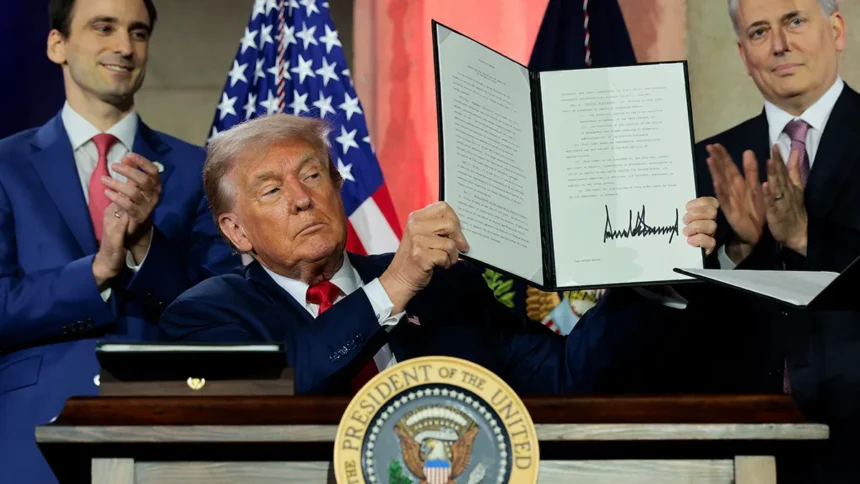
President Donald Trump and representatives of several big technology companies have signed a voluntary pact to improve artificial intelligence safety and governance. As AI systems become more powerful, the agreement requires corporations to enhance internal controls and conduct external evaluations.
The White House discussion also focused on the administration’s overall approach to technology, government services, and national security. At the same time, significant events occurred at the Pentagon, Congress, and other government agencies.
Quick Fact
| Detail | Information |
|---|---|
| What Happened | Trump and major AI leaders signed a voluntary AI safety accord. |
| Where | White House, Washington, DC |
| When | September 29, 2026 |
| Key Participants | Donald Trump and leaders from major AI and technology companies. |
| AI Measures | Internal risk controls, external reviews and board oversight. |
| Government AI | America.gov launched an AI powered question and answer feature. |
| Pentagon Changes | Defense Secretary Pete Hegseth confirmed plans to reduce general and admiral positions by 20%. |
| Federal Funding | The GAO said certain congressionally approved funds cannot remain withheld beyond their legal expiration date. |
| Current Status | The AI agreement remains voluntary, while several related government and military changes are moving forward. |
Trump AI Accord Focuses on Self Regulation
Trump stated that large AI businesses should take greater responsibility for overseeing their own technology. The voluntary agreement has many stages of evaluation.
Companies are urged to tighten their internal risk controls. They also committed to cooperate with independent auditors and assessors. Company boards are expected to consider findings from external assessors.
The agreement does not constitute a new federal legislation. Trump framed the agreements as ethically obligatory, implying that government regulation may still play a role in the future.
The administration also unveiled an artificial intelligence-powered version of America.gov, which attempts to make government information and services more accessible to the public.
Its question-and-answer system first generated comments on some politically contentious topics. Some of these comments contradicted Trump’s previous pronouncements concerning the 2020 election and other problems.
The system later modified certain replies. It began refusing some political questions and said that it did not furnish responses to political requests.
Pentagon Confirms 20 Percent Leadership Reduction
The statement was made during his State of the Force speech on September 30 at Marine Corps Base Quantico. Hegseth also announced a new drone command and other modifications to the military hierarchy.
Senator Jack Reed, the senior Democrat on the Senate Armed Services Committee, had previously challenged the proposed cutbacks. He stated that Congress should be given more information before any substantial changes in senior leadership occur.
The Pentagon has described the layoffs as part of an attempt to eliminate superfluous bureaucracy.
Senate Debate Over Taxpayer Funded Trump Ads
Sen. Maggie Hassan made an effort to pass a Senate resolution declaring that government funds shouldn’t be used to support Trump’s campaign-style commercials.
The political difference reflects the disagreement reflects the disagreement reflects the disagreement.
Jack Smith Defends His Investigation
Former special counsel Jack Smith spoke before the Senate Judiciary Committee to explain his investigations regarding Trump.
Smith denied that politics affected his choices and supported the efforts of his staff. He also indicated he will continue speaking despite fears of prosecution.
Republican members questioned Smith about the probe into plans to contest the outcome of the 2020 election. The ongoing legal and political controversy surrounding those probes was evident at the hearing.
GAO Challenges Trump Administration Funding Action
The Government Accountability Office published an important report concerning federal funding targeted by the Trump administration.
According to the GAO, the president cannot utilize the rescission procedure to prevent congressionally authorized funds from being used once their expiry date has passed. The agency stated that unless Congress takes further action to revoke the monies, they must continue to be accessible.
Trump Plans Midterm Campaign Tour
Trump said he expects to campaign for Republican candidates during the 2026 midterm elections.
He stated that he anticipated visiting many states and outlined a 32-day campaign itinerary. Texas, Alabama, and Nebraska are among the scheduled sites; however, the whole schedule has not yet been made public.
Both parties are getting ready for the elections in November, which coincides with the campaign activities.
Data Centers Remain a Major Issue
Trump justified the building of massive data centers around the country once more.
He maintained that these facilities may assist local communities economically by attracting investment, tax income, and other benefits. Additionally, he recommended that IT corporations provide funds for education and energy supply to local communities.
Data center building has also created controversy concerning power usage, infrastructure and local expenses.
US Faces Major Policy Changes
The Pentagon will proceed with its new organizational structure and anticipated leadership changes.
Conflicts over federal expenditures, government communication, and the role of executive power will also persist between Congress and the administration.
The optional AI pact increases the obligation of IT corporations to keep an eye on their systems. At the same time, the Pentagon is revamping its top leadership structure, while government spending choices remain under legal and congressional scrutiny.