
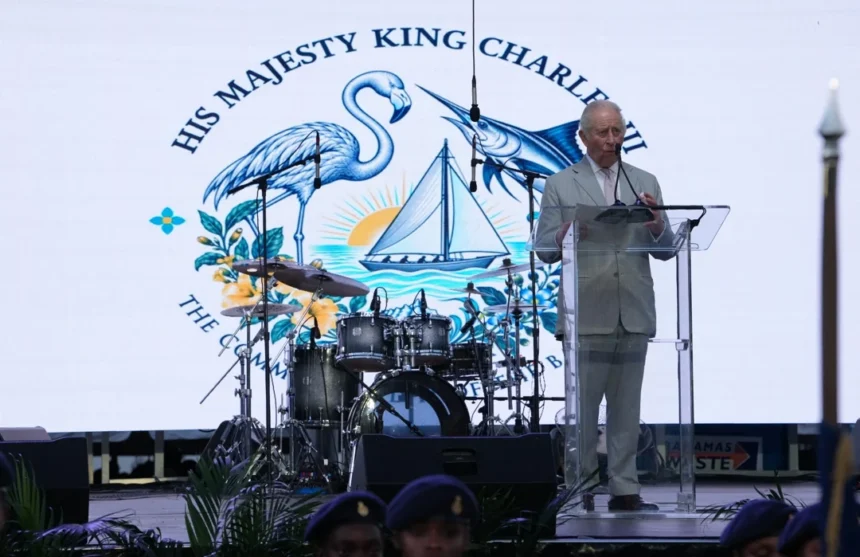
Campaigners have warned that if King Charles doesn’t do more to address the monarchy’s historical ties to slavery, his planned Caribbean visit may hasten efforts to remove him as head of state in a number of nations.
On Tuesday, the monarch will begin a nine-day journey that will include stops in the Bahamas and Guyana, Antigua and Barbuda, and the Commonwealth heads of government meeting (Chogm).
The chair of the CARICOM Reparations Commission, Hilary Beckles, addresses microphones from a podium
At the Caribbean meeting, King Charles encouraged “as human brother” to back restitution negotiations.
Quick Fact
| Detail | Information |
|---|---|
| Main Issue | Slavery reparations and historical accountability |
| Key Figure | King Charles III |
| Region | Caribbean |
| Campaigners' Demand | A formal apology and reparatory justice |
| Proposed Solution | A national truth and reconciliation commission |
| Key Contributors | Bell Ribeiro Addy and Professor Robert Beckford |
| Jamaica's Petition | Expected to be heard by the Privy Council in March 2027 |
| Why It Matters | Historical accountability and Britain’s relations with Caribbean nations |
King Charles Faces Reparations and Apology Demands
During the trip, Charles is scheduled to give three important addresses, but he will heed official advice and refrain from formally apologizing for Britain’s involvement in the transatlantic slave trade. Additionally, the British government has declined to provide restitution.
Protests against the monarchy’s colonial past and calls for a formal apology and reparations are anticipated to greet the visit. It takes place four years after the Prince and Princess of Wales’ contentious Caribbean journey in 2022, when pictures of the pair welcoming Jamaican kids through a wire fence caused a lot of backlash in the area.
Charles comes in a territory that has changed, even if he has gone farther than his predecessors in admitting the monarchy’s historical ties to slavery.
Recent events include Jamaica’s historic slavery reparations petition to the king, which is scheduled to be heard by the UK-based privy council in March of next year, and a UN resolution introduced by Ghana that calls for reparatory justice and declares the transatlantic slave trade to be the greatest crime against humanity.
King Urged to Address Reparations Demands
The UK government and the royal family, according to Labor MP Bell Ribeiro-Addy, who leads the all-party parliamentary group for Afrikan reparations, have failed to take into account a global shift on this topic.
It would be incorrect, in my opinion, to believe that we can keep using clichés. “You have “atrocity,” “deep remorse,” “sorrow,” and now they’re going to say “darkest days,” she said. “I believe the monarch should understand that if what he was doing was even close enough, people wouldn’t continue to raise it.
“It is evident that the monarchy values the Commonwealth.”
King Urged to Support Slavery Truth Commission
Theologian Prof. Robert Beckford of the University of Wolverhampton stated: “I believe that what’s at stake fundamentally is credibility: credibility in the monarchy and that leadership based on his ability to empathize and lead as the head of the Commonwealth.” Additionally, believability depends on one’s capacity to understand Caribbean history.
Beckford, a broadcaster, stated that supporting a national truth and reconciliation commission looking at Britain’s part in slavery would be a “creative way” for the king to handle the reparations controversy, despite the overwhelming requests for apologies.