Building for the Future in Canadian Housing
Canada faces growing pressure to deliver housing that is affordable, fast to build, and environmentally responsible. Rising material costs and higher demand make this challenge more urgent. At the same time, communities expect homes to meet higher standards for quality, comfort, and sustainability.
At the Southern Alberta Institute of Technology, Applied Research and Innovation Services, known as ARIS, is helping meet this need. Through applied research and strong partnerships, ARIS supports better ways to design, build, and operate homes across Canada.
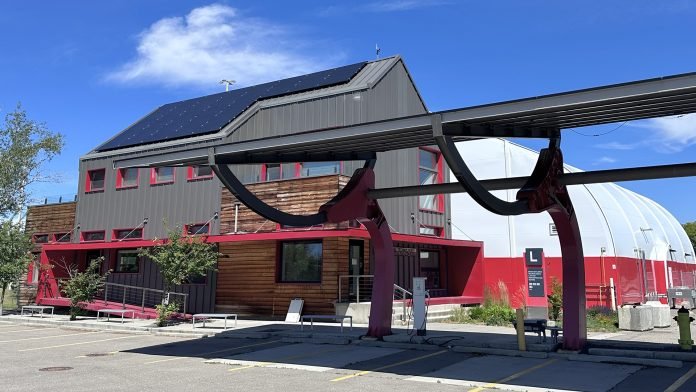
The Role of the Green Building Technology Access Centre
Within ARIS, the Green Building Technology Access Centre, or GBTAC, focuses on practical solutions for the housing sector. Its work spans several key areas, including advanced building materials, energy management systems, environmental design, and the links between affordability and carbon impact.
Rather than stopping at theory, GBTAC connects research directly to real projects. This approach allows builders, policymakers, and communities to test ideas, measure results, and adopt proven methods with confidence.
Turning Research into Real Results
Partnerships sit at the heart of GBTAC’s work. Each project aims to speed up construction while improving energy performance and cutting emissions. At the same time, solutions must remain scalable and affordable.
According to GBTAC leadership, applied research helps ideas move from concept to reality. Once solutions prove themselves in the field, sharing those results openly helps others adopt them faster. As a result, innovation spreads across the sector.
Making Home Ownership More Accessible
For many Canadians, home ownership remains out of reach. High upfront costs, limited financing options, and strict regulations often block entry into the market.
GBTAC addresses these barriers through research linked to the National Housing Strategy. Its work supports policymakers, housing groups, and lenders with evidence-based tools that improve access to ownership.
By studying financial models, construction methods, and energy performance, GBTAC helps reduce costs over the full life of a home. It also helps buyers understand different ownership structures and build long-term financial resilience.
Learning from Proven Ownership Models
GBTAC combines international research with Canadian data to develop practical recommendations. These align closely with the goals of Canada Mortgage and Housing Corporation, which focuses on affordability, access, and equity.
One strong example comes from the Attainable Homes Calgary Corporation. Its model rests on three pillars: low-cost land access, innovative financing such as shared appreciation, and high operational efficiency. Together, these elements cut development costs to about half of traditional projects.
GBTAC plans to share insights from these models with municipalities across Alberta. In doing so, it supports wider adoption of alternative paths to home ownership.
Climate Action Through Better Housing
Homes play a major role in meeting climate goals. Residential energy use accounts for a large share of emissions. Improving energy performance can lower both emissions and household costs.
GBTAC research shows that better design, efficient materials, and renewable systems reduce energy use over time. In addition, features such as stronger insulation and durable materials protect homes from rising energy prices and extreme weather.
Applied research helps turn these ideas into practical building strategies that balance climate action with affordability.
Supporting Net Zero Housing Goals
GBTAC worked with the cities of Calgary and Edmonton to study cost-effective ways to reach higher energy performance levels. The research examined both upfront costs and long-term operating savings.
Findings showed that higher-performance homes often deliver better value over time through lower energy bills. This supports Alberta’s broader emissions reduction plans, which aim to expand net-zero housing.
Both cities now encourage high-performance construction through incentives. Over time, many of these measures are expected to become standard requirements.
Education and Training for a Changing Industry
As building codes evolve, many professionals face uncertainty. New rules raise questions about cost, skills, and practical delivery.
To address this, GBTAC works with local governments and real estate professionals to provide training and tools. These include energy models, material demonstrations, cost studies, and clear roadmaps for meeting new standards.
Through education, GBTAC helps builders and designers adapt with confidence while keeping projects realistic and affordable.
Housing Solutions for Extreme Climates
Canada’s climate presents another challenge. Homes must perform well in extreme cold and increasing heat, often within the same region.
GBTAC supported the Nunavut Housing Corporation in developing strategies for Arctic housing. Many existing designs in the North come from southern regions and fail to address local conditions.
High material costs, supply chain limits, labour shortages, and climate change all add pressure. As a result, energy efficiency and renewable energy become even more important.
Innovation in the Arctic
Through research, GBTAC developed training resources, energy conservation guidance, and new housing strategies for northern communities.
A standout example is Kuugalaaq in Cambridge Bay, Nunavut. This pre-fabricated cultural workspace blends Inuit knowledge with resilient materials and renewable energy systems. It shows how thoughtful design can succeed even in the harshest environments.
Collaboration Driving Long-Term Impact
Building affordable, low-carbon housing requires long term thinking. Rising energy costs and climate risks make durability and efficiency essential.
GBTAC projects focus on reducing energy use, improving building life spans, and planning for systems such as solar and wind. They also explore new financing and ownership models that support affordability over time.
Collaboration strengthens this work. By partnering across Canada and internationally, GBTAC shares knowledge and learns from global experience.
Conclusion
Sustainable housing solutions emerge when research, industry, and communities work together. Through applied research and collaboration, GBTAC helps Canada build faster, smarter, and more responsibly.
This work supports climate goals, improves affordability, and expands access to quality housing. In the process, it helps shape a more resilient and equitable future for communities across Canada and beyond.