
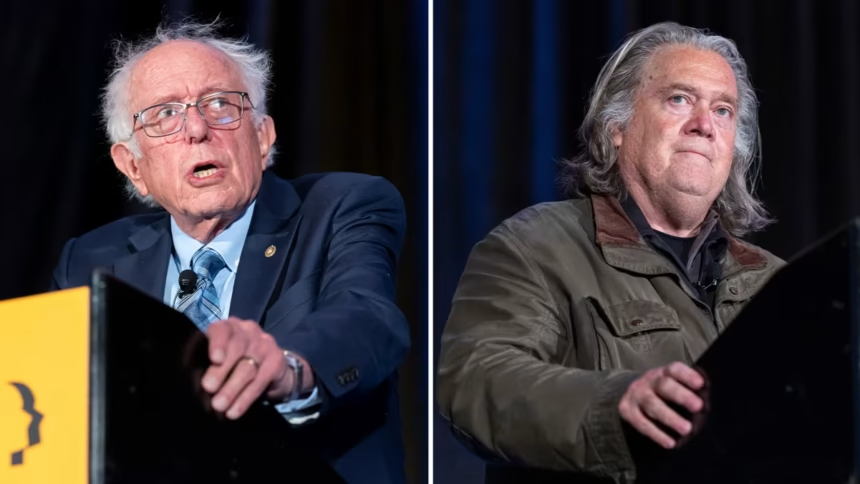
Sen. Bernie Sanders and former Trump adviser Steve Bannon have found an unusual point of agreement: artificial intelligence needs stronger limits.
The two political figures spoke at a “pro human” gathering as concerns about AI safety, jobs, surveillance, elections, and national security continue to grow.
Quick Facts
| Detail | Information |
|---|---|
| What happened | Bernie Sanders and Steve Bannon discussed the risks of artificial intelligence. |
| Where | United States |
| When | September 2026 |
| Who is involved | Bernie Sanders, Steve Bannon, President Donald Trump, AI companies, and US policymakers. |
| Current status | Sanders and Bannon agree that advanced AI needs stronger controls, but they support different approaches. |
| Why it matters | Their unusual agreement highlights growing political concern over advanced AI and its impact on society. |
Sanders and Bannon Unite on AI
Artificial intelligence has become a major political issue in Washington. Sanders and Bannon now share concerns about how quickly the technology is developing.
Sanders warned that AI could replace large numbers of workers. He also raised concerns about mass surveillance, public well being, and election security.
Bannon also questioned the growing influence of AI companies. He argued that Americans should not become dependent on powerful technology companies.
Sanders Calls for Government Action
Sanders has backed a more direct role for the US government in the AI industry.
His proposal includes a one time 50% tax based on the value of AI companies. He wants to use the money to create an American sovereign wealth fund.
Sanders has also supported legislation aimed at preventing superintelligent AI from gaining control beyond human oversight.
Bannon Takes a Different Approach
Bannon does not share Sanders’ approach to international cooperation.
He argued that government action through traditional legislation could take too long. Instead, he wants President Trump to use executive authority to create a new regulatory body.
Bannon also took a harder position toward China. He argued against agreements with Beijing and called for restrictions on Chinese nationals studying or working in US universities and laboratories.
The disagreement shows how two politicians can share concerns about AI while supporting very different solutions.
‘Rise Above Partisanship’
The meeting also highlighted an unusual effort to move the AI debate beyond traditional party lines.
Sanders has criticized Trump’s understanding of AI. Bannon, meanwhile, acknowledged that he and Sanders hold very different opinions about the president.
Still, Bannon said the two sides need to rise above partisan politics when discussing major AI risks.
Neither man expressed strong confidence in the leaders of major AI companies.
Both Sanders and Bannon agree that advanced AI could create serious risks.
Their main areas of agreement include:
- The rapid development of advanced AI needs greater oversight.
- Superintelligent AI could create risks for human control.
- Major AI companies should not have unlimited influence.
- AI could affect jobs, elections, privacy, and national security.
- Government leaders need to address AI risks more seriously.
Sanders favors legislation, taxation, government involvement, and international cooperation.
AI Debate Exposes Political Divide
Bernie Sanders and Steve Bannon have found rare common ground on one major issue: advanced AI needs stronger safeguards.
Their disagreement comes over how to achieve that goal. Sanders favors legislation and international cooperation, while Bannon wants faster executive action and a tougher approach toward China.