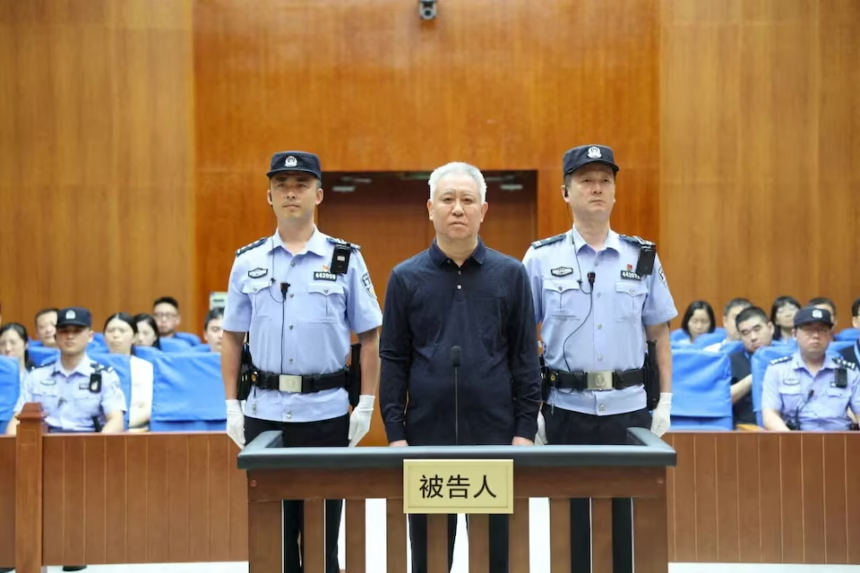
Evergrande founder Hui Ka Yan has been sentenced to life in prison by a court in Shenzhen, China, after pleading guilty to eight financial crimes linked to the property developer’s collapse. The 67-year-old businessman was also ordered to have his personal property confiscated.
The judge delivered the sentence on August 20, 2026. About five years after Evergrande’s financial crisis became a major problem for China’s property market.
The company had defaulted on most of its roughly $300 billion in liabilities, leaving creditors, investors and homeowners facing major losses.
Quick Facts
| Detail | Information |
|---|---|
| What happened | Hui Ka Yan was sentenced to life in prison. |
| Where | Shenzhen, Guangdong province, China |
| When | August 20, 2026 |
| Who is involved | Hui Ka Yan, China Evergrande Group and Hengda Real Estate |
| Current status | Hui has received a life sentence, while Evergrande's liquidation continues. |
| Why it matters | The case is closely linked to the collapse of one of China's biggest property developers and the wider property crisis. |
Hui Ka Yan Gets Life Sentence
Hui Ka Yan received a life sentence from the Shenzhen Intermediate People’s Court on Thursday.
The court said the criminal conduct involving Hui, Evergrande and its main subsidiary Hengda Real Estate involved extremely large amounts of money and caused serious economic losses and social harm.
Hui pleaded guilty in April to eight charges. The charges included misuse of funds, fundraising fraud, illegally taking public deposits, illegally extending loans, fraudulent securities issuance and bribery.
The court also ordered the confiscation of Hui’s personal property.
Evergrande was fined 8.82 billion yuan, about $1.31 billion. Hengda Real Estate received a separate fine of 7 billion yuan.
Chinese state media CCTV reported that 56 other people connected to Evergrande, excluding Hui, also received sentences on Thursday.
Evergrande Investors Demand Their Money
Hui had not been seen publicly since Chinese authorities detained him in 2023 after Evergrande defaulted on its debt.
Evergrande’s failure to repay billions of dollars in wealth management products also affected small investors. Some homeowners and investors expressed their financial losses following the company’s collapse.
Comments shared in an Evergrande homeowners’ social media group included:
“All ordinary citizens have paid the cost.“
“Imprisonment is meant to protect him. If he comes out, his life is in jeopardy.“
“What about our money?”
These comments show that the criminal sentence has not resolved the financial concerns of people who lost money through Evergrande’s collapse.
Evergrande’s liquidators declined to comment on Hui’s sentence.
Hui Ka Yan and Evergrande's Rise and Fall
Hui Ka Yan founded Evergrande in 1996 after growing up in a rural village in China’s Henan province. He was raised by his grandmother and previously worked as a steel technician.
Under Hui’s leadership, Evergrande expanded rapidly and became China’s biggest property developer by contracted sales.
The company’s growth depended on borrowing. As its debt increased, Evergrande became increasingly exposed to problems in China’s property market.
In 2017, Hui’s reported net worth reached $45.3 billion, making him Asia’s richest person at the time, according to Forbes.
Evergrande’s financial problems became increasingly serious as China’s property sector weakened. The company defaulted on most of its approximately $300 billion in liabilities.
A Hong Kong court ordered Evergrande to be liquidated in 2024. The company was later delisted from the Hong Kong Stock Exchange.
Why Evergrande's Collapse Matters to China
The Evergrande case is important because the company’s collapse became a major part of China’s property crisis.
The developer’s facing financial problems affected more than shareholders. Creditors, homeowners, investors, and suppliers were also affected by the collapse.
Evergrande’s failure also showed the risks faced by companies that expand rapidly while carrying very large amounts of debt.
For creditors, Hui’s criminal punishment does not mean their money will automatically be recovered. The liquidation process is separate from the criminal case and involves attempts to recover and distribute Evergrande’s remaining assets.
Evergrande's Liquidation Continues
The company remains involved in a lengthy liquidation process.
According to its liquidators, about $255 million worth of assets had been sold by August 2025. Creditors had submitted claims totaling about $45 billion.
Liquidators are also pursuing offshore assets linked to Hui and his former spouse. They are seeking to recover about $6 billion in dividends and remuneration paid to Hui and other former executives.
The life sentence follows earlier action against Hui by China’s securities regulator.
In 2024, the regulator fined Hui $6.6 million and banned him from China’s securities market for life.
The regulator said Evergrande’s flagship property unit had inflated its earnings and committed securities fraud.
The latest criminal case resulted in a much more serious punishment, with Hui receiving a life sentence.
What Happens Next for Evergrande and Creditors
Hui will serve the life sentence imposed by the Shenzhen court unless the judgment is changed through the applicable legal process.
Evergrande’s liquidation will also continue as creditors and liquidators seek to recover assets.
The life sentence handed to Hui Ka Yan marks a major legal development following the collapse of Evergrande, once one of China’s largest property developers.
The case has also highlighted the wider consequences of China’s property crisis. While Hui has now received a severe criminal punishment, creditors, investors and other affected groups still face a lengthy process to recover their losses.