President Donald Trump has issued an executive order requesting a national voter ID requirement, urged Congress to approve a proof-of-citizenship bill, and attempted to restrict mail-in voting through reforms to the U.S. Postal Service.
None of those initiatives were successful in time to influence the midterm elections this year. In the United States, the situation is different.
Quick Fact
| Detail | Information |
|---|---|
| What Happened | Ohio introduced new voting requirements. |
| Location | Ohio, United States |
| When | 2026 |
| Key Changes | Proof of citizenship for certain voter registration transactions and stricter mail ballot deadlines. |
| Who Is Involved | Ohio lawmakers, the ACLU of Ohio, and voters. |
| Legal Status | The ACLU of Ohio has challenged the law. |
| Why It Matters | The rules could affect voter registration and ballot access. |
New State Voting Laws Take Effect
More than three dozen voting regulations adopted in Republican-controlled states are going into effect for the first time this year; some of these laws contain elements of Trump’s stalled plans. These include changes to the kinds of IDs that are permitted to register for the first time, as well as requirements to present proof of citizenship, which the Republican president has tried but failed to push through Congress.
“Trump’s attacks on our elections are deeply damaging, not happening in isolation,” said Sophia Lin Lakin, head of the American Civil Liberties Union’s Voting Rights Project.”Nationwide, states are also progressing.
Republican politicians who back stricter voting regulations, particularly those pertaining to voter ID, see them as sensible adjustments that contribute to increased electoral trust.
Since the president made false accusations of massive fraud in his 2020 election defeat to Democrat Joe Biden, Trump and other Republicans have been advocating for more regulations. Republican supporters have responded favorably to Trump’s fabrications; despite all the evidence to the contrary, the majority of them think Biden was not duly elected. Trump’s own attorney general found no proof of widespread fraud, and he lost hundreds of legal battles.
Changes to voter ID requirements are challenged
State Representative Donald McFarlane of New Hampshire stated that he sponsored the measure to ban student IDs from being used for voting since universities are not subject to the same regulations as governmental organizations.
He stated that his measure had bipartisan support and that “the change removes a special exception and applies the same government-issued ID standard to all voters.”
He stated that state IDs are still available to students at no cost.
There have been challenges to the new criteria.
According to Kathryn Johnson, president of the League of Women Voters of South Dakota, “proof of citizenship in itself is not terrible.”
Voter ID Rules Raise Access Concerns
“Because our state is somewhat remote, sometimes it requires a drive, and you have to coordinate, take time off work, and all of these kinds of things,” she explained.
In recent debates, several Democrats have also stated that they support voter ID. Josh Shapiro, the governor of Pennsylvania, stated that he was amenable to the concept provided it wasn’t predicated on “conspiracy theories.” Legislators usually allow election officials and voters time to adjust when they amend their state’s voting rules. Trump’s law will go into effect right now, requiring voters and election officials to comply in the midst of the midterm elections.
Ohio seeks to scrub voter rolls
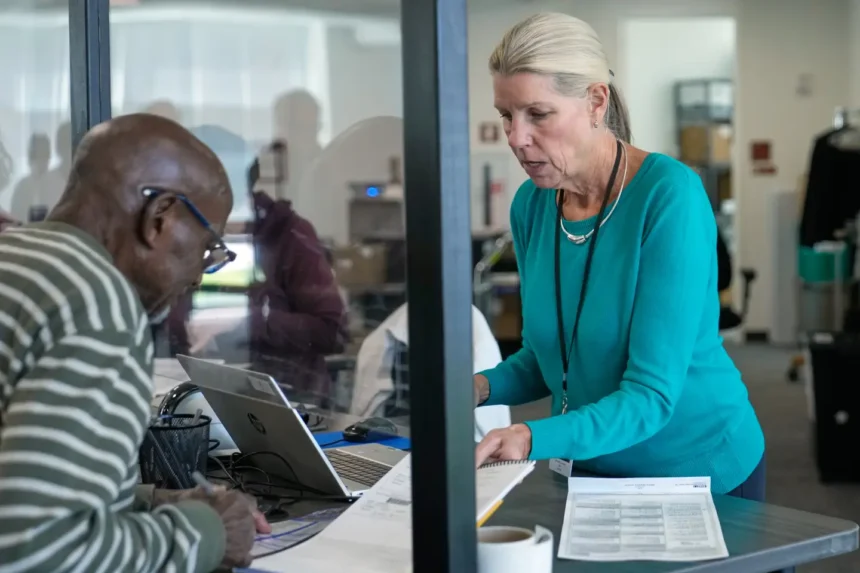
For the first time this year, those registering to vote or changing their voter registration information at a Bureau of Motor Vehicles site in Ohio must provide evidence of citizenship. Additionally, the state removed the four-day grace period for mail-in votes, which must now be delivered by Election Day to local election offices.
However, a continuous cleansing of the state’s voter rolls is the main worry of voting rights organizations. According to Freda Levenson, the databases used to verify citizenship against voter registration records may be out of current.
Voters have mixed views on the changes
Dan Walter, an independent voter and retired steel worker, stated at an early voting facility in Wayne County, Ohio, that he is against demanding citizenship documentation in order to cast a ballot.
“I think it’s to prevent people from voting,” he remarked.
His wife, Jody, a Democrat and former aerospace executive, had similar sentiments on Ohio’s new voter registration law.
“All they ask for right now is a driver’s license, which doesn’t prove citizenship,” she stated.
She stated, “I just think you need to be a citizen and show proof of ID.”