
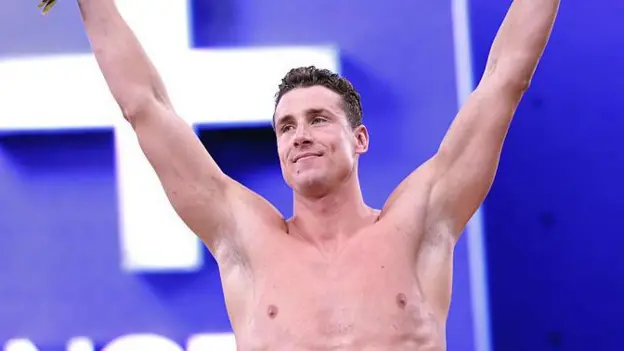
Record Swim at Controversial Event
Kristian Gkolomeev from Greece delivered the fastest time ever recorded in the 50m freestyle, clocking 20.81 seconds in Las Vegas. His swim beat the official world best of 20.88 seconds set by Cameron McEvoy.
Despite the result, sporting authorities will not recognise the time. The event does not follow international anti doping rules and allows performance enhancing drugs.
Why the Result Is Not Official
Global bodies such as the International Olympic Committee and the World Anti Doping Agency reject the competition. Athletes at the event are allowed to use substances banned in official sport.
World Aquatics also criticised the competition, calling it a spectacle built on shortcuts. Officials argue that results from this setting cannot count as official records.
Conditions and Rewards at the Event
Gkolomeev competed using a polyurethane suit, which is not allowed in sanctioned races. Organisers rewarded him with 250 thousand dollars for winning and added a 1 million dollar bonus for the unofficial record.
He said the result changed his life and would support his family. He also indicated he plans to return next year to attempt another record.
Other Performances at the Enhanced Games
Fred Kerley from the United States won the 100m sprint in 9.97 seconds. He did not match his personal best of 9.76 seconds.
British swimmer Ben Proud won the 50m butterfly in 22.32 seconds. His time was close to the world record but did not surpass it. He expressed frustration at missing a record.
Emily Barclay from Britain won the women 50m freestyle in 24.09 seconds. This was slower than the official world record.
Strongman athlete Hafthor Bjornsson also competed but did not break his 510 kilogram deadlift record.
Debate Around Drug Use in Sport
The Enhanced Games allows substances approved for medical use in the United States, including testosterone and growth hormones. These are banned in traditional sport.
Organisers say controlled enhancement is safer and more transparent than hidden doping. Critics argue it threatens fair competition and undermines sport integrity.
Public Reaction and Attendance
The event took place in front of about 2500 invited spectators. Tickets were not sold to the general public.
Many sports authorities publicly criticised athletes who took part. Some organisations may impose bans on competitors in future events.