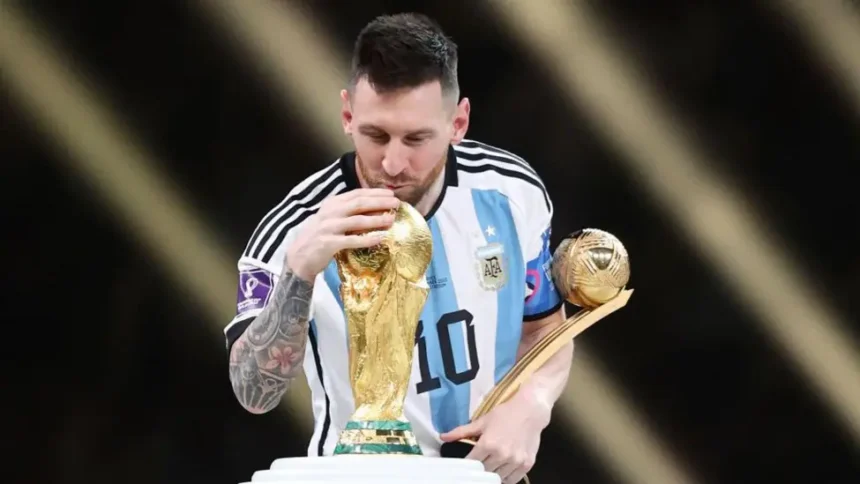
Lionel Messi continues to prove why he is considered one of football’s greatest players. At the 2026 World Cup, the Argentina captain has shown a new version of himself, relying less on speed and more on intelligence, creativity, and game control.
Argentina are aiming to become the first team since 1962 to successfully defend their World Cup title. Messi remains the key figure in their journey, leading the team with his experience and incredible performances.
At 39 years old, Messi has delivered another historic tournament. He has scored eight goals and provided three assists, putting him among the leading contenders for the Golden Boot alongside France’s Kylian Mbappe.
Messi’s New Style: Less Running, More Influence
The Messi of today looks very different from the young player who made his Barcelona debut in 2003. Earlier in his career, he dominated matches with explosive runs, dribbling skills, and constant movement.
Now, Messi controls games through positioning, passing, and decision making. He creates more chances while using less energy.
During this World Cup, Messi has attempted 33 shots and created 21 chances, giving him a combined total of 54 goal creating actions. This is the highest number recorded by a player since Diego Maradona in 1986.
One of the most surprising statistics is his movement. Messi has walked for around 47% of the distance he covered during matches, the highest percentage among outfield players in the tournament.
He averages only 8.2 kilometres per 90 minutes and completes around 2.7 sprints per match. Four years earlier, that number was 5.3 sprints per game.
Despite moving less, Messi remains highly effective because he understands space better than almost any player in football history.
Argentina Rely on Messi’s Experience
England will face a difficult challenge in the semi final against Argentina. Stopping Messi has become one of football’s biggest tasks.
In his last 15 World Cup appearances, only Poland managed to prevent him from scoring or assisting. During those matches, Messi recorded 16 goals and seven assists.
His ability to influence important games has remained unmatched, even as his physical style has changed.
How Guardiola Helped Transform Messi
When Messi started his career at Barcelona, he played mainly as a right winger. His speed and dribbling made him a dangerous attacking player.
However, former Barcelona manager Pep Guardiola saw that Messi could become even more influential in the centre of the pitch.
At first, Guardiola moved Messi away from the wing because he did not provide enough defensive support. Soon, the manager realised Messi’s best position was closer to the heart of the attack.
This decision changed football history.
The Birth of the False Nine Role
In 2009, Guardiola placed Messi in a new position during Barcelona’s famous match against Real Madrid at the Santiago Bernabeu.
Instead of playing as a traditional striker, Messi dropped deeper into midfield areas. This movement created confusion for defenders.
If defenders followed him, they left space behind. If they stayed back, Messi received the ball freely.
The strategy worked perfectly. Barcelona won 6 to 2, and Messi introduced a new attacking style that changed modern football.
During this period, Messi reached another level. Between 2011 and 2013, he scored 96 goals in 69 La Liga matches.
Messi’s Understanding of Football Grew
Messi’s success was not only based on talent. His understanding of tactics also improved throughout his career.
He later explained that Guardiola helped him understand important football concepts, including movement, space, and ball possession.
From a young winger to a creative midfielder and now a complete football leader, Messi has constantly adapted.
His latest World Cup performance shows that true greatness is not only about speed or physical strength. It is about intelligence, experience, and the ability to change with time.