Hidden Italian Coastline
Riviera of Ulysses is a scenic coastline between Rome and Naples that combines natural beauty with ancient mythology.
Located between Rome and Naples, this stunning, lesser-known shoreline has strong connections to The Odyssey and is a more tranquil.
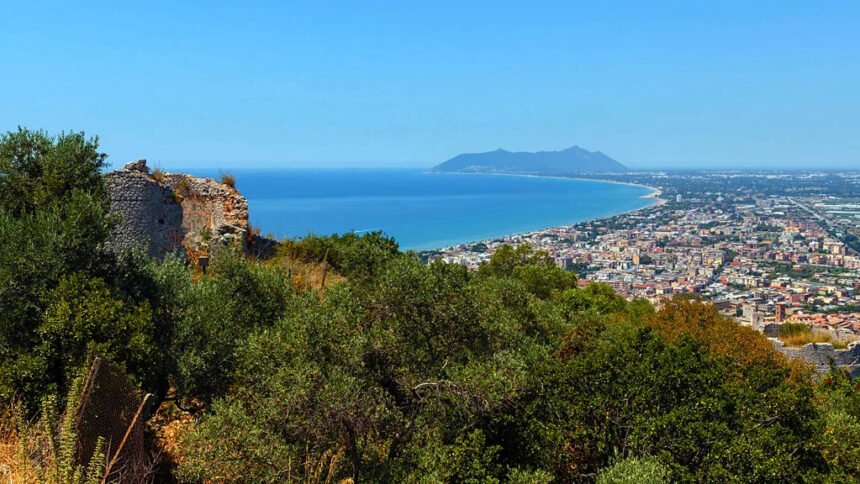
You can see a mountain promontory that appears to rise from the sea from Terracina, the Italian coastal town where my family originates from.
It is jagged and squat. My father has always remarked that the way she glides on the waves resembles the profile of a witch.
The roughly 43-mile (70-kilometer) stretch that stretches between Rome and Naples, hugging the Tyrrhenian Sea and passing through a number of beach cities.
From the shore or from the top of mountains, we can see it. It shines in sharp contrast to the sunset every evening, and no two are ever the same.
The mountain is known as Monte Circeo (Mount Circeo) on the map. However, we refer to this small area of Italy.
la Maga Circe (Circe the Sorceress) throughout the Riviera di Ulisse (Riviera of Ulysses). We say that Circe transformed Odysseus’s troops into pigs there.
For almost three millennia, people have been captivated by Homer’s ancient Greek epic, The Odyssey.
It’s the talk of the season thanks to Christopher Nolan’s latest homage. However, we are constantly reminded of the myth on this little-known Italian coast.
How a myth comes to pass
Travelers may be surprised to learn that several of the Odyssey’s most well-known episodes are strongly connected to Southern Italy. Because the story is so fundamentally Greek. Many city names and geographical features have Odyssean roots.
Before traveling to the island of Aeaea, where he meets Circe, Odysseus’s ship first lands in the Land of the Laestrygonians in Book 10, “The Bewitching Queen of Aeaea”.
There is no proof that Homer ever traveled to Italy or even existed. However, according to local archaeologist Lorenzo Ceruleo. His writings were well-liked by the colonizing sailors by the time the Ancient Greeks arrived in Italy in 750 BC.
Terracina was designated as the Land of the enormous, cannibalistic Laestrygonians, and Monte Circeo as Aeaea. connecting Monte Circeo and Aeaea.
The term “Riviera di Ulisse” was created in the 20th century to market the area, despite the coast’s longstanding connection to The Odyssey.
The communities between San Felice Circeo on the slopes of Mount Circeo and Scauri on the Gulf of Gaeta are usually included in the classification.
But there is some local disagreement. The neighboring Pontine Islands and the southern coastal villages of Formia and Gaeta, often known as the Land of the Laestrygonians.
According to Ceruleo, “places frequently compete over myths.” “However, the Laestrygonians were always associated, even in the earliest traditions, with Terracina.”