
Facing the Unknown
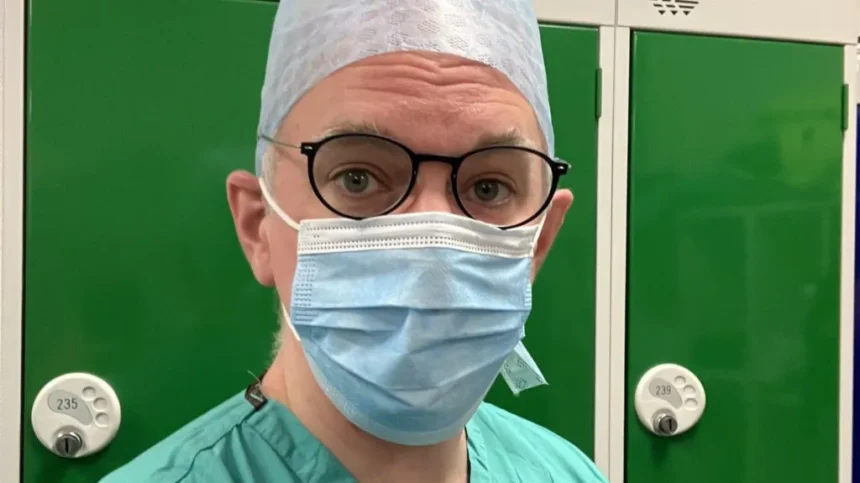
I’m at Edinburgh Royal Infirmary, observing brain surgery to see if Alzheimer’s could ever be cured. Wearing scrubs, I stand at the back of the operating theatre. A dozen medical staff move with focused calm amid the beeping and pumping of machinery.
Above, large screens show an MRI scan. A bright white mass reveals a tumour that began in the patient’s colon and spread into his brain.
Cutting Through the Cortex
The cortex is the outer layer of the brain that controls language, memory, and thought. Using a surgical drill, Prof Brennan removes a flap of skull.
Next to me, Dr Claire Durrant, an Alzheimer’s researcher at the University of Edinburgh, holds a container of ice-cold artificial cerebrospinal fluid, designed to mimic the liquid around the brain and spinal cord.
A Precious Gift
Normally, the removed brain tissue is discarded. Prof Brennan places a small section, about the size of a thumbnail, into the jar.
In the back of the car, I realize that piece of brain was recently part of a man’s thoughts and fears.
“I’m always aware that what we receive is a precious gift, given on probably the worst day of that person’s life,” Dr Durrant says.
Studying Living Brain Tissue
Her lab works with living adult brain tissue to better understand dementia and other neurological diseases. “By developing these techniques, we hope to move toward a world free from many horrible brain disorders,” she explains.
In the UK, around one million people have dementia, with Alzheimer’s being the most common.
Preparing the Tissue
Dr Durrant’s team studies the brain to uncover Alzheimer’s’ fundamental biology.
The four scientists work together like a pitstop team. First, they embed the brain sample in jelly. Then they slice it into sections 10–20 brain cells deep.
Testing Toxic Proteins
The lab exposes the slices to amyloid and tau proteins, which accumulate in Alzheimer’s.
Everything Dr Durrant has seen gives her hope. “Right now, I don’t believe Alzheimer’s is inherently part of being human,” she says. “Disease can be cured, and the evidence suggests we could do the same with Alzheimer’s.”
She concludes, “I’ve never seen as much hope in Alzheimer’s research as I do now. I’m really hopeful we’ll see meaningful progress in my lifetime.”