Historic Views from Artemis II Mission
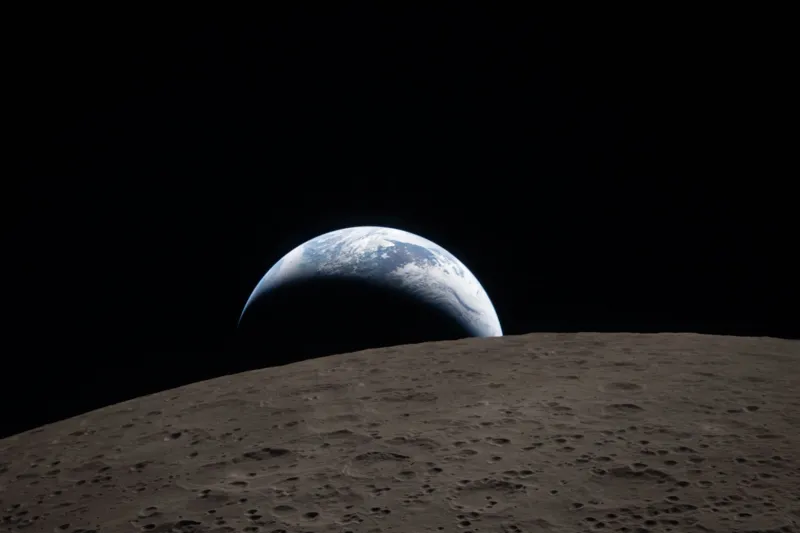
NASA has released the first images captured by astronauts during the Artemis II flyby of the Moon. These photos offer a rare and powerful view of space, showing both Earth and the Sun from a unique perspective.
‘Earthset’ Image Stuns Viewers
One of the images shows an “Earthset.” In this view, Earth appears just above the Moon’s rugged surface. The blue planet looks small and distant against the dark space background.
This moment reminds many people of the famous Earthrise image taken by Bill Anders during the Apollo 8 mission in 1968. That earlier image became one of the most important environmental photos in history.
Rare Solar Eclipse Captured
The second photo shows a dramatic solar eclipse. Astronauts witnessed this event as the Moon moved between the Sun and their spacecraft. The image captures the Sun’s light blocked by the Moon, creating a striking visual effect in space.
Six-Hour Flyby and Radio Silence
Astronauts took these photos during a six-hour journey around the Moon. At one point, their spacecraft moved behind the Moon. During this phase, communication with Earth stopped due to radio blackout.
The images were taken through the window of the Orion spacecraft. One key photo was captured at 18:41 Eastern Daylight Time.
Details Visible from Space
NASA shared more details about the Earthset image. The dark side of Earth shows nighttime, while the sunlit side reveals cloud patterns over Australia and Oceania.
In the foreground, the Ohm crater stands out. It has terraced edges and a flat floor. Scientists say such craters form when the lunar surface melts during impact and then rises to create central peaks.
A Reminder of Earth’s Fragility
These images highlight how small and delicate Earth looks from space. Like the Earthrise photo, they remind us of our planet’s place in the vast universe.
The Artemis II mission continues to build excitement for future human exploration of the Moon and beyond.