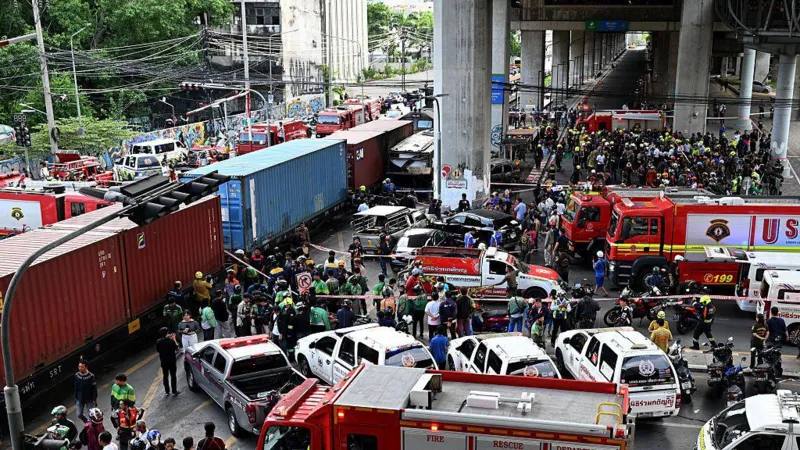
Deadly Train and Bus Crash
A tragic collision in Bangkok has left eight people dead and many others injured after a freight train struck a public bus at the Asoke Din Daeng railway crossing. The bus caught fire after the impact, making the situation more severe for passengers trapped inside.
The incident happened on Saturday afternoon when heavy traffic caused the bus to stop directly on the railway tracks. Witnesses and early reports suggest the crossing barriers could not lower in time because of congestion in the area.
Train Driver Tests Positive for Drugs
Thai police confirmed that the train driver involved in the crash tested positive for drugs during a urine screening. Authorities have charged him with reckless driving following the deadly incident.
Officials have not revealed which specific substance was found in the test results. Investigations are still ongoing to determine how impairment may have affected the driver’s actions.
Emergency Response and Early Findings
The train’s emergency braking system was activated too late to prevent the crash. Reports from investigators indicate it began braking roughly 100 meters before impact, which was not enough to stop in time.
The collision caused the bus to catch fire shortly after impact. Emergency teams rushed to the scene, but several passengers could not be saved due to the intensity of the blaze.
Multiple Charges and Safety Questions
Authorities have also charged the bus driver and the crossing guard responsible for operating the barrier system. In this location, the barrier is controlled manually, which has raised further safety concerns.
Officials have now ordered mandatory drug and alcohol testing for all train drivers and rail staff before their shifts. The move comes as part of an urgent review of railway safety procedures across the country.
Dangerous Crossing and Urban Pressure
Safety experts warn that the Asoke Din Daeng crossing carries extremely heavy traffic, with estimates suggesting more than one hundred thousand vehicles pass through daily. This level of congestion exceeds safe design limits for such crossings.
Motorcyclists are often seen crossing aggressively, sometimes bypassing safety barriers to avoid delays. Over time, this behavior has become normal in the area, increasing risk for everyone using the crossing.
Experts also point out that the railway lines were built long before the surrounding city expanded. As Bangkok grew around the tracks, traffic pressure increased, creating constant safety challenges.
Risk Becoming Routine
Specialists describe the situation as a case of normalised risk. People begin to accept danger as part of daily life. This mindset can lead to serious accidents when warning systems and traffic discipline fail at the same time.