
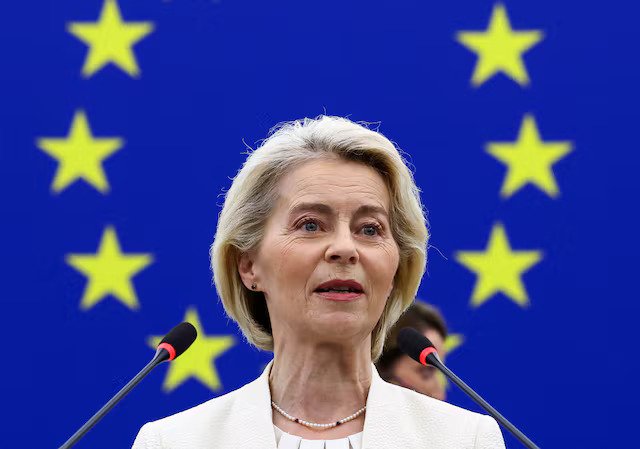
European Commission President Ursula von der Leyen has backed calls to slow the development of advanced artificial intelligence. She made the remarks during her State of the Union address to the European Parliament in Strasbourg on September 16, 2026.
Von der Leyen also said she plans to invite leading frontier AI laboratories to discuss ways to manage the risks linked to increasingly powerful models. The proposal comes as several major AI leaders call for more caution around the pace of development.
Quick Fact
| Detail | Information |
|---|---|
| What happened | Ursula von der Leyen backed calls to slow advanced AI development. |
| Where | European Parliament, Strasbourg, France |
| When | September 16, 2026 |
| Who is involved | Ursula von der Leyen, EU institutions and major frontier AI labs |
| Current status | Von der Leyen plans talks with leading AI laboratories. |
| Why it matters | The EU wants stronger safety measures as AI systems become more capable. |
Von der Leyen said the risks from advanced AI are becoming clearer as frontier models improve.
She highlighted concerns about powerful AI systems being used for cyberattacks. She also pointed to recent incidents involving AI agents and warnings from people working in the industry.
Her comments follow calls from AI executives for a slower approach to frontier model development. Anthropic CEO Dario Amodei has recently argued for reducing the speed of capability development. OpenAI CEO Sam Altman and xAI founder Elon Musk have also expressed support for greater caution.
Frontier AI Labs Could Join EU Talks
The EU wants to work with international partners, including Canada and the United Kingdom. Areas under discussion include model testing, verification, early warning systems and AI security.
The European Commission is positioning its existing AI rules as part of a wider effort to address emerging risks. The bloc also wants international cooperation as advanced AI becomes more widely used.
Europe’s Wider AI Approach
The EU wants to play a larger role in setting international standards for advanced AI.
Von der Leyen said cooperation with countries such as Canada and the United Kingdom could help improve the testing and security of powerful models.
The goal is not only to regulate AI within Europe. The Commission also wants wider cooperation on risks that can cross national borders.
EU Calls for Slower AI Development
The next step will be discussions between the European Commission and leading frontier AI laboratories.
Von der Leyen’s announcement puts AI safety higher on the EU’s political agenda. Her proposed talks with frontier AI companies could bring regulators and technology developers into closer discussions about the pace of development.
The central issue is how governments and AI companies can support useful innovation while improving safeguards for increasingly powerful systems.