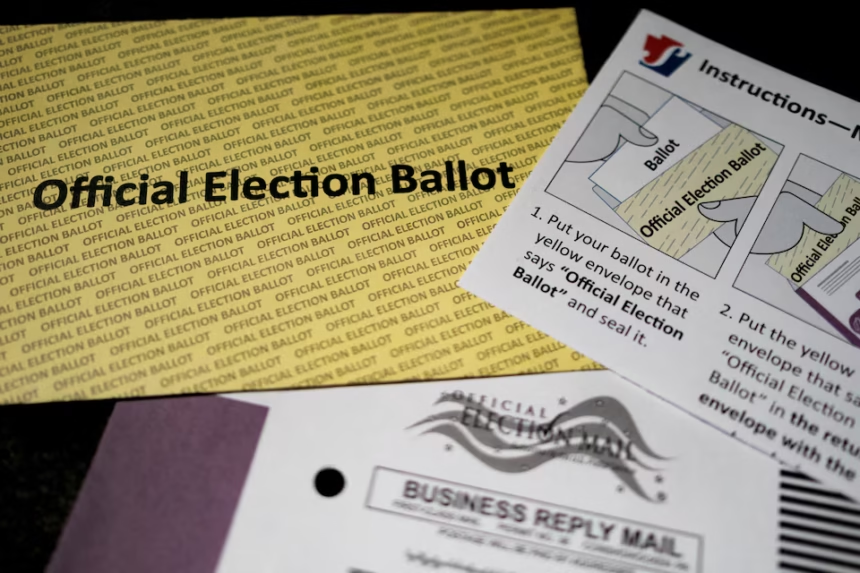
A federal judge in Boston has blocked key parts of a new U.S. Postal Service rule that would tighten requirements for mail in voting ahead of the November 2026 congressional elections.
U.S. District Judge Indira Talwani issued a temporary restraining order on Thursday. The order came after Democratic-led states and voting rights groups challenged the new requirements.
Quick Facts
| Detail | Information |
|---|---|
| What happened | A federal judge blocked key parts of a new USPS rule affecting mail in voting. |
| Where | Boston, Massachusetts, United States |
| When | Thursday, August 27, 2026 |
| Who is involved | U.S. Postal Service, President Donald Trump, Democratic led states, and voting rights groups. |
| Current status | The temporary restraining order will remain in place for 14 days. |
| Why it matters | The rule could affect how voters request, send, and receive mail ballots before the 2026 elections. |
Judge Blocks Key USPS Mail in Voting Requirements
Judge Indira Talwani stopped the U.S. Postal Service from enforcing key parts of the new mail in voting requirements.
The rule came from an executive order signed by President Donald Trump in March. It would introduce new standards for mail ballot envelopes and voter information.
Under the rule, states would have to provide USPS with lists of people receiving mail ballots. Ballot envelopes would also need unique barcodes.
USPS could refuse to deliver ballots that fail to meet the new requirements. The agency could also reject ballots linked to voters who do not appear on state provided lists.
Judge Talwani said the rule could create serious problems for voters who depend on mail ballots.
Why the Judge Blocked the Rule
The judge questioned whether the Postal Service had shown enough evidence to justify the new requirements.
She also said the rule could interfere with the power states have to manage their own elections.
According to the ruling, the new system could create a major risk of voters losing access to mail ballots.
The judge also raised concerns about the short time available for states to prepare.
States could need to purchase new envelopes and equipment. They could also need to create new systems and train election workers.
The temporary restraining order will remain in place for 14 days.
Judge Talwani plans to hold a hearing on September 3. At that hearing, she will consider whether to issue a longer preliminary injunction against the rule.
The legal challenge came from Democratic led states and voting rights organizations. The American Civil Liberties Union is among the groups opposing the new requirements.
The White House and USPS had not immediately responded to requests for comment at the time of the report.
Mail In Voting Rules Across the United States
Mail in voting remains available in some form across all 50 states.
According to the information provided, 29 states allow voters to request a mail ballot without giving a specific reason.
Eight states conduct their elections entirely by mail.
The scale of mail voting has also grown significantly. USPS said it processed nearly 100 million ballots during the 2024 election.
About 30 percent of voters nationwide cast their ballots by mail during that election, according to state data cited in the report.
Trump Administration and Mail Ballots
President Donald Trump has pushed for tighter rules on voting by mail for years.
His administration’s March executive order directed USPS to introduce new requirements for mail ballots.
The issue has remained politically sensitive since the 2020 presidential election.
Trump has repeatedly made claims about widespread voter fraud connected to that election. Those claims have faced extensive scrutiny and rejection from election officials and courts.
The latest court fight now puts the federal government’s authority over mail voting under renewed legal pressure.
What Happens Next for Voting?
The next major development is expected at the September 3 court hearing.
Judge Talwani will consider whether the temporary order should become a longer preliminary injunction.
The legal dispute could continue beyond that hearing. Other courts and the U.S. Supreme Court may also become involved as the case develops.
The outcome could influence how states and USPS handle mail ballots during the 2026 congressional elections.
The ruling focuses on concerns about voter access, state election authority and the practical burden of implementing the new rules.
The September 3 hearing will be an important next step. Until then, the temporary restraining order keeps the disputed requirements on hold.