
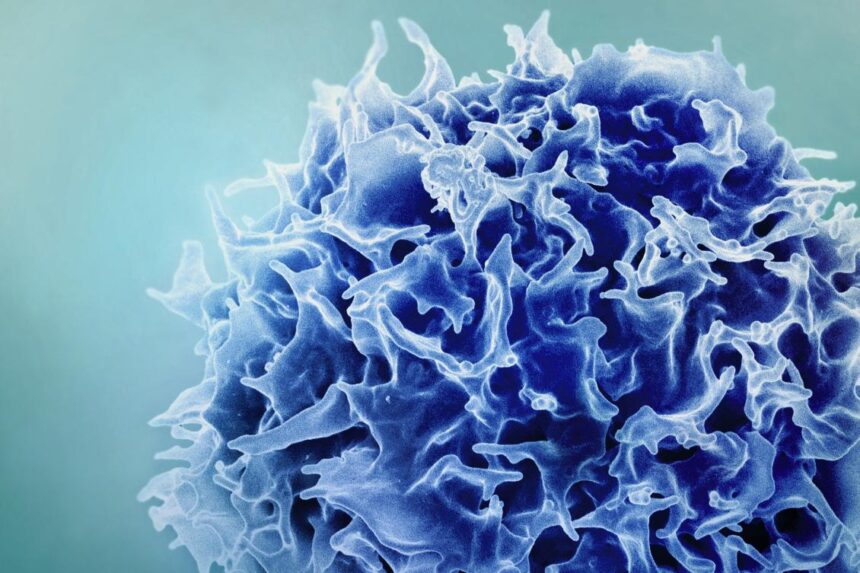
Researchers at MIT have found a strategy to use the liver to combat age-related T-cell reductions (shown), increasing the body’s reaction to vaccination and restoring T-cell counts.
People’s immune systems deteriorate with age. People become more vulnerable to a range of diseases as T cell counts shrink and are unable to respond to pathogens as fast.
Researchers at MIT and the Broad Institute have discovered a method to temporarily instruct liver cells to enhance T-cell function in an effort to reverse that decline. This reprogramming can make up for the thymus’s age-related deterioration, which is where T cell maturation typically takes place.
According to the researchers, this kind of medication could help people live better lives as they age if it is developed for use in patients.
According to Feng Zhang, the James and Patricia Poitras Professor of Neuroscience at MIT, who also holds joint appointments in the departments of Brain and Cognitive Sciences and Biological Engineering, “if we can restore something essential like the immune system, hopefully we can help people stay free of disease for a longer span of their life.”
K. Lisa Yang and Hock E. Tan Center for Molecular Therapeutics at MIT and Harvard, a researcher at the Howard Hughes Medical Institute,
Thymus Shrinkage Weakens Immune Protection
T-cell growth is greatly aided by the thymus, a little organ situated in front of the heart. Immature T cells undergo a checkpoint procedure in the thymus to guaranty a varied repertoire of T cells. Additionally, the thymus secretes growth hormones and cytokines that aid in the survival of T cells.
But the thymus starts to diminish in early adulthood. The generation of new T cells decreases as a result of this process, which is called thymic involution. The thymus is significantly diminished by the age of about 75.
Engineering the Liver to Boost Immunity
Delivering T cell growth factors into the circulation has been the focus of earlier research on immune system rejuvenation, although this can have negative side effects. Additionally, scientists are investigating the potential of employing transplanted stem cells to aid in the thymus’s functional tissue regeneration.
The MIT scientists adopted a different strategy, hoping to establish a transient “factory” in the body that would manufacture the T-cell-stimulating signals typically released by the thymus.
Liver Based Therapy Boosts T Cell Production
The researchers discovered three immunological triggers that are crucial for T-cell maturation in order to build their factory. These three elements were encoded into mRNA sequences that lipid nanoparticles could transport. These particles build up in the liver after being injected into the bloodstream, where hepatocytes absorb the mRNA and start producing the proteins it encodes.
T cell populations significantly increased in size and function following this therapy.
Cancer Immunotherapy Responses
The researchers discovered that the mRNA treatment can also increase the immune system’s reaction to cancer immunotherapy.
After administering the mRNA treatment, 18-month-old mice were given tumor implants and given a checkpoint inhibitor medication.PD-L1 was created to help release the immune system’s brakes and encourage T cells to target tumor cells.
The study was partially supported by the Broad Institute Programmable Therapeutics Gift Donors, the Pershing Square Foundation, J. and P. Poitras, the K. Lisa Yang Brain-Body Center, a member of the Yang Tan Collective at MIT, the Howard Hughes Medical Institute, and an EMBO Postdoctoral Fellowship.