
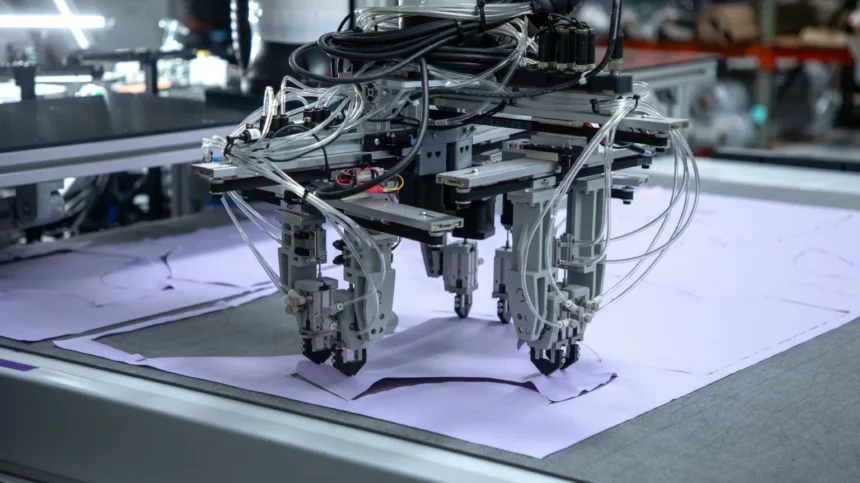
From factories to fashion production
Robots already work in car factories, hospitals, and airports. They can assemble complex machines and even assist in surgeries. But clothing production has remained mostly manual. Sewing fabric is still difficult for machines because soft materials shift during handling.
Why sewing is hard for robots
Fabric is flexible and moves during stitching. Robots struggle to keep two pieces perfectly aligned while working in motion. This makes traditional sewing automation slow and unreliable at scale.
Cam Myers, founder of CreateMe, explains that alignment is the main challenge. His company decided to avoid sewing altogether and use a different approach.
A new method using adhesive
Instead of stitching, CreateMe uses glue to join fabric pieces. A robot applies adhesive, then presses layers together with precision. This process removes the need for needles and thread.
The company already uses this system to produce women’s underwear. It plans to start making t shirts soon, with large scale production expected in the near future.
Potential impact on global clothing production
Today, most garments are made in Asia by low paid workers. Only a small share is produced in Western countries like the United States and the United Kingdom.
CreateMe believes automation could shift production closer to home. Some clients want clothing labeled as made in the United States using locally sourced cotton and materials.
The company says even moving a small portion of t shirt production back to the United States could reshape the industry. It also believes automation could reduce environmental impact by shortening supply chains.
However, this shift could also affect millions of textile workers who rely on garment manufacturing jobs.