A rapidly changing landscape
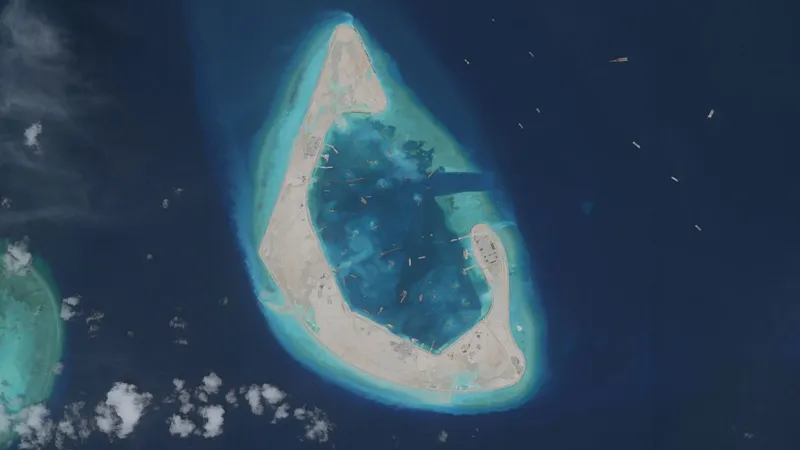
Antelope Reef, located in the north west of the South China Sea, has changed beyond recognition. Until recently, it was mostly underwater and barely visible above the waves. Now it has become a newly formed island stretching around six square kilometres, built in just half a year.
Satellite images show a bright white sand formation shaped like a crescent. Small structures have already appeared on one side. Inside the lagoon, a large number of vessels are operating, believed to be powerful dredging ships used to reshape the seabed.
Massive dredging operations reshape reefs
China operates one of the largest dredging fleets in the world. Some of these ships can move around 6,000 cubic metres of sand per hour. That is enough material to fill two Olympic sized swimming pools in a single hour.
Millions of tonnes of sand have been extracted from the seabed to create solid ground. The speed of this transformation is among the fastest recorded for such projects.
Regional powers expand their presence
China is not acting alone in reshaping reefs in the region. Vietnam has also begun strengthening and expanding reefs under its control in response to earlier Chinese projects. The Philippines and other claimants are also carrying out smaller scale construction activities.
These developments reflect growing competition over territory in the South China Sea.
Disputed waters and rising tensions
The South China Sea is claimed by China, Taiwan, Vietnam, the Philippines, Malaysia, and Brunei. Most of the reefs involved were once submerged and had no permanent population.
China took control of the Paracel Islands in 1974 after a conflict with South Vietnamese forces. Since then, it has expanded its presence significantly across the region.
In recent years, China has built artificial islands on reefs such as Mischief, Fiery Cross, and Subi in the Spratly Islands. These islands now support airstrips and military facilities.
Military concerns and strategic messaging
China’s coastguard and maritime militia regularly patrol within its claimed nine dash line boundary. This has increased tensions with neighbouring countries, especially the Philippines, where several confrontations have occurred at sea.
The shape and construction style of Antelope Reef suggests the possibility of future military use, including a potential runway. However, China already operates nearby airstrips on Woody Island and Hainan Island.
Analysts suggest the latest expansion may be less about immediate military need and more about signalling control over the region