
How Warehouse Robots Work
Every time you click “buy” on an online order, the chances are that your purchase starts getting processed within minutes.
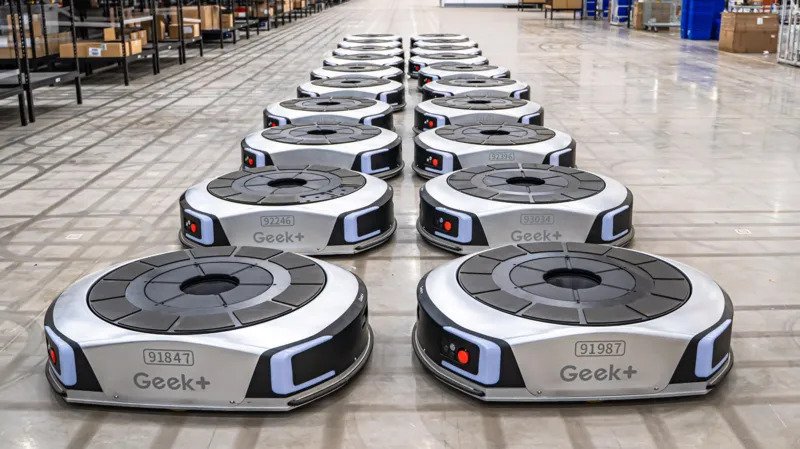
Increasingly, the journey starts with a squat silver floor robot gliding beneath a storage rack, lifting a shelf and carrying it across a warehouse to a waiting worker.
At Geek+’s factory in the eastern Chinese city of Hefei, fleets of the robots are built and tested before being shipped to warehouses around the world.
Some of Britain’s biggest retailers – including Tesco, Asda and Next – now use the company’s technology.
According to economists, broader robotics use is necessary if companies are to become more productive.
The Organization for Economic Co-operation and Development (OECD) stated that robots will be essential to increasing productivity in its 2026 study SME Technology Adoption in the United Kingdom.
The OECD notes that although UK businesses have adopted advanced digital technology, they fall behind in robotics and automation, calling Britain’s low robotics adoption “surprising” considering its industrial past.
For businesses like Geek+, that offers a chance. Despite having one of the biggest logistics and e-commerce industries in Europe.
Warehouse Automation Gains Speed Across Britain
With UK partner MotionTech deploying over 2,000 robots across ten warehouse facilities, Britain has already emerged as Geek+’s largest European market.
Fast deployable solutions are what customers desire, according to Barry Pemberton, Account Director at MotionTech.
“They want high volume, high storage, rapid choosing… eventually on a smaller footprint with a decreased headcount.”
“There appears to be a severe labor shortage in the UK right now. These technologies are crucial for maintaining corporate success and satisfying consumer demand.
Robotics should be used to enhance jobs and increase production rather than just reduce labor expenses, according to the Trades Union Congress.
China Makes Robotics a National Priority
It encouraged ministers to make sure employees are included in choices regarding automation and those firms. They invest in retraining in response to the government’s consultation on a new AI and innovation policy.
The TUC stated in its study, “Working with technologists, workers, and unions can help steer UK research and innovation towards workers’ priorities for automation, avoiding job-cutting, low-productivity automation.”
Pallets and whole shelves may be moved throughout warehouses using Geek & robots.
President Xi Jinping’s push to create what he refers to as “new quality productive forces” has made robotics a strategic priority for Beijing.
As China’s working-age population declines, officials are beginning to view automation as crucial to preserving and improving productivity.
China's EV Industry Fuels Robot Innovation
“The robotics story builds directly on China’s electric vehicle ecosystem,” says Brookings Institution scholar Kyle Chan.
What he refers to as “overlapping industrial ecosystems” are being created by the things. The growing usage of batteries, electric motors, cameras, sensors, and semiconductors designed for electric vehicles (EVs) in China’s robotics industry.
Chinese EV manufacturer XPeng is one business spearheading that transition; last year, it presented Iron, a humanoid robot.
He Xiaopeng, the company’s founder, claims that XPeng is no longer only a car manufacturer.He told the press.
“We want XPeng to be a high-tech company.” “In the future, any car company will transform into a car and robotics company.”