The Met Office predicts that this summer will be the warmest in UK history.
For the rest of August, ordinary conditions are sufficient to break the record established just a year ago.
According to data, the UK’s temperature is high for the current meteorological summer (1 June to 10 August) at 16.48°C (61.66°F). This was 1.88°C higher than the average from 1991 to 2020.
UK Summer 2026 Sees Repeated Heatwaves
The average national temperature for the summer of 2025, including both daytime highs and nighttime lows, was 16.10C (60.98F).
It is consistent with data showing that summers are becoming hotter and are probably going to grow drier due to climate change.
Already, 2026’s summer has been remarkable.
After a heatwave in late spring that broke the May temperature record, there was another one in June and a third in July that persisted for two weeks in certain areas.
Numerous locations have seen numerous heatwave thresholds over the summer due to subsequent heatspikes.
In the UK, there have been 37 consecutive days of heatwaves this year.
On June 26, a temperature of 38C was recorded in Lingwood in Norfolk, the hottest temperature of the summer thus far.
With the Met Office issuing an amber excessive heat warning for several parts of England on Thursday, it is feasible that this may be matched or perhaps exceeded later this week.
In August of 2020, Heathrow and Kew Gardens experienced temperatures of 36.4C, the last time we witnessed temperatures over 36C.
The regions of England under an amber warning for excessive heat are shaded in amber on this map of the United Kingdom.
They consist of London, Oxford, and Birmingham. A white text box indicates that the warning will be in effect on Thursday from 0900 to 2359.
caption for an image,
Drought and water pressure increase
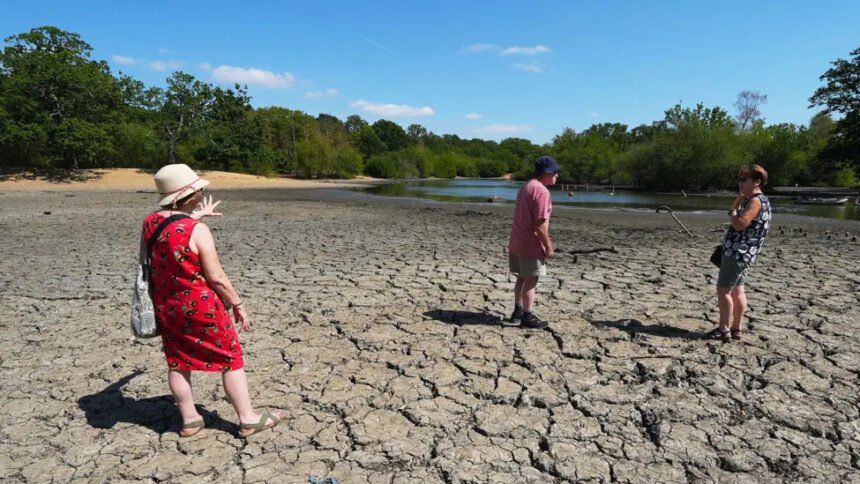
More than two-thirds of England and all of Wales have declared drought because to the exceptionally warm and sunny summer.
In England, 45 million people currently reside in drought-affected areas, and over 27 million of them are subject to water consumption restrictions.
For the majority of this week, England and Wales are not expected to get any rain.
There may be some indications of rain arriving in the UK from the Atlantic on Sunday, according to forecasts.
Some areas of Wales and southern England may see a period of rain as low pressure brings in rain-bearing weather fronts.
There may be the first bit of proper, even if it doesn’t appear to be very heavy or consistent right now.
Rain May Bring Relief After Weeks of Dry Weather
There may be some indications of rain arriving in the UK from the Atlantic on Sunday, according to forecasts.
Some areas of Wales and southern England may see a period of rain as low pressure brings in rain-bearing weather fronts.
Although it doesn’t appear to be very intense or long-lasting right now, many people may experience their first significant downpour in over two months.
Dry, cracked land with trees and a fence in the distance
Picture source
According to National Drought, water supplies are under stress throughout all of England.
Although the endurance of high-pressure weather systems in recent months has been exceptional, scientists have long warned about this kind of summer because of climate change.
What is causing the extreme summer heat?
Hot weather becomes considerably more likely and intense when average temperatures increase, mostly as a result of global fossil fuel use.
Temperatures are expected to rise over 35C once more during this week’s heatwave. This implies that this year, May, June, July, and August will all have surpassed that milestone.
It was extremely uncommon for temperatures to ever hit 35 degrees Celsius in any given year in the late 20th century.
Scientists caution that as carbon emissions continue to warm the earth, summers will continue to become hotter on average, even tho temperatures will still fluctuate from year to year.
As a result, heatwaves in the future will be able to reach temperatures much greater than those of similar weather systems in the past.