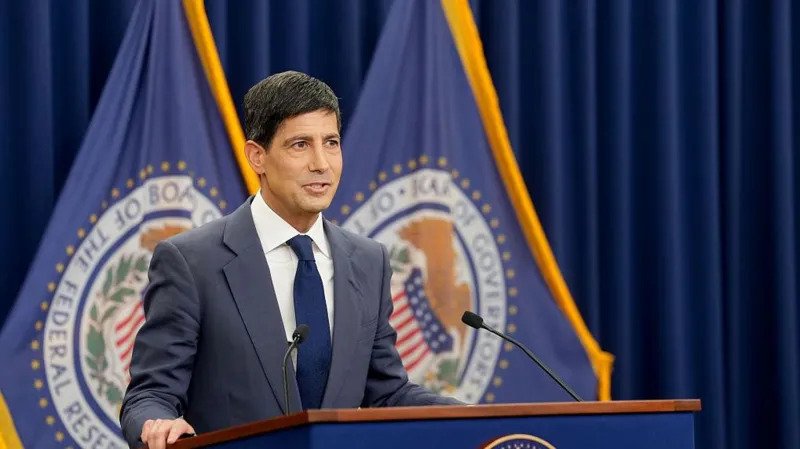
Federal Reserve decision holds rates firm
The US Federal Reserve has decided to keep interest rates unchanged at 3.5% to 3.75% after its latest policy meeting led by new chair Kevin Warsh. The decision came as policymakers assessed ongoing inflation pressure and rising global uncertainty linked to tensions involving the US, Israel, and Iran.
Inflation and global risks shape debate
Inflation in the US remains above the central bank’s target at around 3.8%. This kept pressure on officials, some of whom supported a possible rate increase to control price growth.
At the same time, uncertainty around President Donald Trump’s efforts to secure a deal to end the conflict with Iran added further caution to the outlook. The Fed said economic activity is still growing at a solid pace, even with these external risks.
Split views inside the Fed
Members of the Federal Open Market Committee showed disagreement on the next steps for interest rates. According to projections, nine of the 18 officials expect at least one rate increase this year. Eight expect rates to remain steady, while only one predicts a cut.
This mix of views highlights the lack of agreement on how aggressively the Fed should respond to inflation.
Policy message becomes shorter under Warsh
The Fed also changed how it communicates policy decisions. The latest statement was much shorter than previous updates, reflecting Warsh’s push for simpler messaging.
Officials removed earlier language that hinted at future rate cuts. The new statement focused mainly on price stability and current economic strength.
Trump reacts to Fed stance
President Donald Trump reacted briefly to the decision, saying it was acceptable and avoiding a strong position. He suggested that rate hikes would be harmful for the economy, but also expressed support for Kevin Warsh, saying he trusted his approach.
Economic outlook remains uncertain
While job growth and business investment remain steady, policymakers continue to face mixed signals. Inflation is still above target, and geopolitical tensions continue to cloud the outlook for future rate decisions.