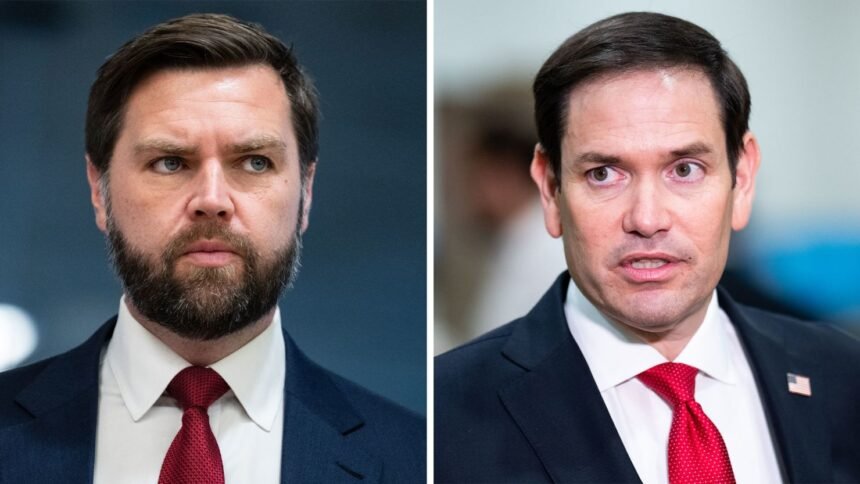
The Republican Party is already facing questions about its future after Donald Trump. Attention is increasingly turning to Vice President JD Vance and Secretary of State Marco Rubio.
The two Republicans offer different explanations of where the party should go next. Vance has focused on industrial policy, economic change and a less interventionist foreign policy. Rubio has continued to make the case for capitalism, American leadership and Western values.
Quick Facts
| Detail | Information |
|---|---|
| What happened | JD Vance and Marco Rubio have presented different views on the future of the Republican Party. |
| Where | The discussion centers on US politics, economic policy, and foreign affairs. |
| When | The debate is gaining attention as Republicans look toward the 2028 election. |
| Who is involved | JD Vance, Marco Rubio, Donald Trump, and Republican voters. |
| Current status | Vance is being discussed as a potential 2028 contender, while Rubio has said he will not run for president. |
| Why it matters | Their different views could influence the Republican Party after Trump. |
JD Vance Pushes New Republican Economic Vision
JD Vance and Marco Rubio are emerging as two important figures in the debate over the Republican Party’s future.
Vance has used recent public appearances to explain his vision for the movement. In his book, Communion, he connects his religious journey with his political views.
The discussion then turns toward economics and the future of American industry.
Vance has criticized the movement of American manufacturing overseas. He has also questioned an economic model that relies heavily on services and finance.
During a conversation with Joe Rogan, Vance argued that Republicans need to address economic frustration. He said voters could become more attracted to socialism if they believe the American economic system no longer offers a fair path to success.
Vance Offers a Different Republican Vision
Vance has increasingly presented himself as a critic of traditional Republican economic thinking.
His approach places greater emphasis on American industry and working-class communities. He also favors a more restrained approach to foreign intervention.
That position has helped distinguish him from parts of the traditional Republican establishment.
However, his critics argue that he sometimes portrays free market economics too simply. They also question some of his comments about foreign governments and international conflicts.
His media appearances have also attracted attention because he discusses subjects beyond traditional policy debates.
Rubio Makes the Case for Capitalism
Marco Rubio presents a different vision.
In recent remarks, Rubio strongly criticized communism. He argued that communism does not offer an attractive vision of society, even in theory.
Rubio has also become known for making traditional conservative arguments in a clear and forceful way.
That could give him an advantage among Republican voters who want the party to return to a more traditional defense of capitalism and Western political values.
His role as secretary of state also gives him direct experience with international affairs.
Foreign Policy Could Become a Major Divide
Foreign policy may become another important difference between Vance and Rubio.
The discussion highlights Vance’s preference for negotiations with US adversaries. Rubio, meanwhile, has taken a more traditional approach to American foreign policy.
The transcript also compares US efforts involving Iran with diplomatic work involving Lebanon and Israel.
These situations could develop further. As a result, it is too early to draw firm conclusions about how foreign policy might shape a future Republican primary.
Is Vance Already the 2028 Favorite?
Political commentator Matt Continetti argues that Vance currently has several advantages.
As vice president, Vance has a direct connection to the Trump administration. He also benefits from his position within the Republican Party and his frequent public appearances with Trump.
The biggest advantage may simply be his proximity to the president.
Still, history offers plenty of reasons for caution. Vice presidents have often struggled to win the presidency after serving under another president.
Trump’s own decisions could also change the race. The former and current president has spoken positively about both Vance and Rubio while avoiding a clear endorsement of either man as his successor.
Could Vance and Rubio Run Together?
For now, the idea of Vance and Rubio competing against each other may be less certain than the possibility of them eventually appearing on the same ticket.
Trump has publicly joked about the pair forming a future Republican ticket.
Vance has also suggested that Trump remains focused on governing rather than creating a public contest over his successor.
That leaves the 2028 question open.
Vance and Rubio Shape GOP’s Future
The debate between Vance and Rubio reflects a larger question inside the Republican Party.
Should the party continue moving toward economic nationalism, industrial policy and a more restrained foreign policy?
Or should Republicans place greater emphasis on free markets, traditional conservatism and American leadership abroad?
Vance and Rubio represent different answers to those questions.
Their positions may become even more important as Republicans begin thinking about the party after Trump.
JD Vance and Rubio Shape 2028 Race
The 2028 Republican race is still far from settled.
Vance has a strong political platform as vice president. Rubio has experience in foreign policy and a reputation for delivering traditional conservative arguments.
Much will depend on Trump, the economy, foreign policy developments and the mood of Republican voters.
JD Vance and Marco Rubio represent two different directions for the Republican Party.
Vance is pushing a populist economic message that challenges parts of traditional Republican thinking. Rubio is making a stronger case for capitalism, Western values and traditional conservative principles.