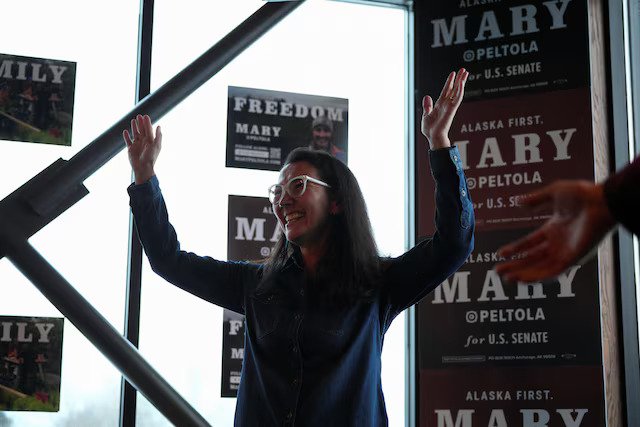
Florida and Alaska delivered two sharply different results in Tuesday’s U.S. primary elections, creating new challenges and opportunities for both major parties ahead of the November midterms. In Florida, Democratic socialist Angie Nixon defeated better funded centrist candidate Alexander Vindman for the Democratic Senate nomination, while in Alaska, former Democratic Rep. Mary Peltola advanced alongside Republican Sen. Dan S. Sullivan.
The results could affect the battle for control of the U.S. Senate. Florida remains strongly Republican, making Nixon’s path to victory difficult, while Alaska is emerging as a more competitive Senate contest after Peltola received more votes than Sullivan in the state’s nonpartisan primary.
Quick Facts
| Detail | Information |
|---|---|
| What happened | Florida and Alaska held major primary elections on August 18, 2026. |
| Florida Senate result | Angie Nixon won the Democratic nomination and will face Republican Sen. Ashley Moody. |
| Alaska Senate result | Mary Peltola and Dan S. Sullivan advanced to the November election. |
| Main political issue | The results could influence the fight for control of the U.S. Senate. |
| Trump backed candidates | President Donald Trump had mixed results among candidates he supported. |
| Next major stage | The candidates will compete in the November general election. |
What Happened in the Florida Senate Primary?
Angie Nixon defeated Alexander Vindman in Florida’s Democratic Senate primary, producing one of the biggest surprises of Tuesday’s elections.
Nixon, a Democratic socialist and Florida state representative, defeated Vindman despite raising less than $1 million for her campaign. Vindman raised more than $16 million and had national recognition from his role as a witness during Donald Trump’s first impeachment.
Nixon will now face Republican Sen. Ashley Moody in November. Moody won the Republican primary and will defend the Senate seat in the general election.
The result is significant because Florida has moved strongly toward the Republican Party in recent elections. That makes the November contest a difficult challenge for Democrats, even after Nixon’s unexpected primary victory.
Florida Senate Race: Why Nixon’s Win Matters
Nixon’s victory is another sign of growing competition inside the Democratic Party between centrist candidates and progressive candidates.
Vindman was widely viewed as a candidate who could appeal to moderate voters in a Republican leaning state. Nixon instead won the Democratic nomination with a more progressive political profile.
Her victory follows several other primary contests in which progressive Democratic candidates have challenged more established candidates.
Not every progressive candidate succeeded in Florida. Oliver Larkin lost his primary challenge to Democratic Rep. Jared Moskowitz in the 25th Congressional District, while progressive challenger Elijah Manley finished third in the 20th Congressional District.
Florida Remains a Republican Stronghold
Tuesday’s results also reinforced the Republican Party’s strength in Florida.
Republican candidates received roughly 1.6 million votes in the statewide Senate and governor contests, compared with about 1.2 million votes for Democratic candidates, according to Reuters.
Florida is also using a new congressional map approved by the Republican controlled state legislature. The map could help Republicans gain additional seats in the U.S. House during the November election.
Republican Rep. Byron Donalds also won the Republican nomination for governor. If he defeats Democratic nominee David Jolly in November, Donalds would become Florida’s first Black governor.
Alaska Senate Primary Gives Democrats an Opening
Alaska produced a very different result.
Former Democratic Rep. Mary Peltola performed strongly in the state’s nonpartisan Senate primary and advanced to the November general election with Republican incumbent Dan S. Sullivan. Peltola received more votes than Sullivan in the primary, giving Democrats renewed interest in a state that has not elected a Democratic senator since 2014.
Peltola previously represented Alaska in the U.S. House but lost her reelection bid in 2024. She returned to statewide politics by challenging Sullivan for his Senate seat.
Alaska uses a system in which the top four candidates in the primary advance to the November election. The presence of another candidate named Dan J. Sullivan has added an unusual element to the Senate race.
Two Dan Sullivans Add Confusion to Alaska Race
Another candidate, Dan J. Sullivan, a retired schoolteacher, also competed for the Senate seat.
His candidacy has drawn criticism from Republicans who say voters could confuse him with incumbent Sen. Dan S. Sullivan. The U.S. Justice Department is investigating the matter, according to a source cited by Reuters.
Dan J. Sullivan has said he entered the race because he was frustrated with the incumbent and does not intend to mislead voters.
The final list of four candidates advancing from Alaska’s primary was still being determined in early results, with the fourth position particularly close.
Trump’s Endorsements Produce Mixed Results
President Donald Trump had mixed results in Tuesday’s Republican primaries. His endorsed candidates Byron Donalds, Sydney Gruters and Harriet Hageman won their races, while Catalina Lauf and Rep. Cory Mills lost.
Mills was defeated by former TV anchor Ryan Elijah in Florida. Trump had urged Mills to leave the race and later backed Elijah.
Florida Voters Continue to Use Mail Ballots
Florida’s primary also highlighted a difference between Trump’s criticism of mail voting and the voting behavior of many Florida residents.
About 1.15 million Floridians voted by mail in Tuesday’s primaries, according to state figures. Another 818,000 voted early in person, while about 1.3 million voted in person on Election Day.
Trump himself voted by mail in Florida, according to media reports.
The White House said this did not conflict with Trump’s broader position on mail voting, arguing that he would support exemptions for people who cannot vote in person. White House spokesperson Olivia Wales said: “As everyone knows, the President is a resident of Palm Beach and participates in Florida elections, but he obviously primarily lives at the White House in Washington, D.C.”
The Alaska Senate contest could become important in the national battle for Senate control.
Peltola’s strong primary performance suggests Democrats have a serious candidate in a state that has traditionally favored Republicans in federal elections. Sullivan remains a strong Republican candidate, and the November contest is expected to receive significant national attention.
The Florida race presents a different picture. Nixon’s primary victory gives Democrats a progressive nominee, but Florida’s Republican advantage makes the Senate contest a difficult path for Democrats.
What Happens Next?
The focus now shifts to the November general election.
In Florida, Angie Nixon will face Republican Sen. Ashley Moody in the Senate race. Byron Donalds will face Democrat David Jolly in the governor’s race.
In Alaska, Mary Peltola and Dan S. Sullivan will campaign for the Senate seat, while the final candidates advancing from the top four primary positions must be confirmed through the state’s election process.
The November results will help determine the balance of power in Washington.
Conclusion
The August 18 primaries produced contrasting results for Democrats and Republicans. Angie Nixon’s upset victory in Florida gives Democrats a progressive nominee in a difficult Republican state, while Mary Peltola’s strong showing in Alaska gives Democrats a more promising Senate opportunity.
President Trump also saw mixed results among his endorsed candidates, showing that his influence remains significant but does not guarantee victory in every Republican primary.