
SpaceX Rocket Crashes Into Moon
It is thought that a rogue SpaceX rocket fell into the Moon, creating a crater close to a well-known lunar landmark and providing scientists with a rare study opportunity that may aid future expeditions.
The Falcon 9 rocket’s empty upper stage was scheduled to hit the Moon close to the Einstein crater at a speed of around 5,400 mph (8,700 km/h).
Planetary geologists view this unintentional collision as a scientific gift. Even if it may take days or even weeks to fully understand what transpired and what we may learn from it.
The reusable Falcon 9 rocket from Space X has been sent into orbit on many occasions.
A portion of the rocket can return to Earth because to its design, while other portions are lost in space.
In January of last year, the rocket sent two lunar landers into space from Florida.
Its mission was completed when it fired the upper stage with sufficient force to launch both landers out of Earth’s orbit and onto a route toward the Moon.
SpaceX Rocket Nears Moon Impact
The Earth, Moon, and Sun’s moderate gravitational pull, as well as the Sun’s light, provided a slight push throughout the course of the following 18 months.
Eventually, astronomers monitoring the rocket portion discovered that those tiny nudges had set it on a path to the Moon.
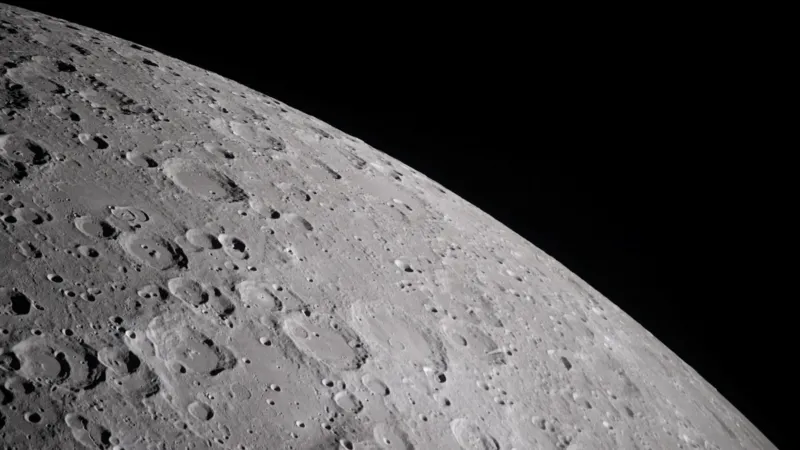
An image of the moon with the Apollo 11 landing location in the southwest and the Einstein Crater. Where the SpaceX rocket component was supposed to crash, in the north.
NASA Tracks Moon Impact Site
Even spacecraft in orbit around the Moon were not in a position to see the impact in real time.
The Danuri orbiter from South Korea had the best chance because it had just passed close to the collision site.
Korean media has been informed by its team that any footage would only be made public when researchers have finished their investigation.
Strong telescopes in the Americas, where the sky was still black, may have provided the science and most likely the first pictures.
Even so, it would be 385,000 kilometers away to detect a 14-meter object striking a sunlit portion of the lunar surface.
Moon Crash Helps Future Exploration
The fresh crater created by the spaceship in orbit, however, will excite a lot of people.
Since scientists already know the rocket’s exact size, speed, and location of contact, this collision is no longer an accident but rather a rare, controlled experiment.
Engineers will need to know how much rock and dust an impact creates and how far flying debris may travel.
How much the ground may tremble nearby in order to build safer landers and future Moon bases.
Moon Impact Reveals Ancient Secrets
In addition to what scientists already know about how the Earth-Moon system developed some 4.5 billion years ago. Material pushed up from below the surface provides new insights into the Moon’s geology.
The Moon has already been impacted by a man-made item. Numerous spacecraft have collided with it since 1959.
The first was the Soviet probe Luna 2, which was followed throughout the years by NASA’s Ranger probes in the 1960s.
A number of rocket stages from the Apollo period, and more recently, the LCROSS mission in 2009, which was purposefully destroyed in order to look for water ice.
The remaining launcher from a Chinese lunar mission launched back in 2014 was believed to be the cause of the last verified unintentional collision, which occurred in 2022.