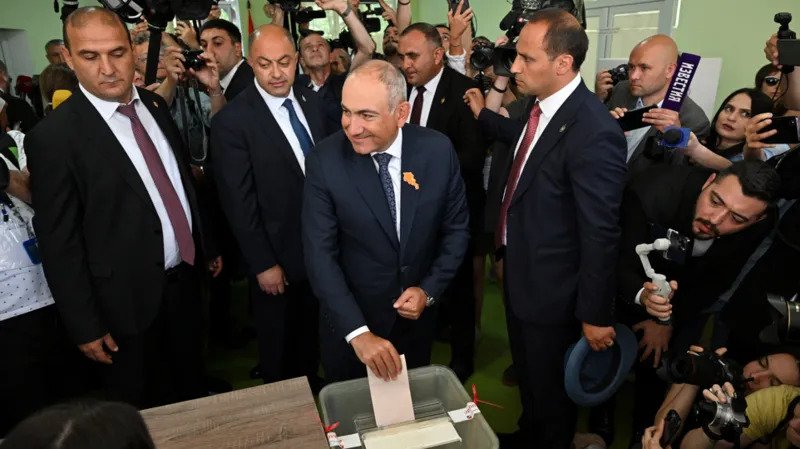
Pro-West Victory in Armenia’s Election
Armenia’s ruling Civil Contract Party, led by Prime Minister Nikol Pashinyan, has won a key parliamentary election seen as a turning point in the country’s foreign policy direction. The party secured 49.8 percent of the vote, ahead of the Strong Armenia Alliance with 23.2 percent. The Armenia Alliance finished third with 9.9 percent.
Although the result showed strong support, early projections indicated Civil Contract crossed the 50 percent mark, allowing Pashinyan to declare victory.
Election Held in a Tense Political Climate
The vote came after a difficult period for Armenia, following its military defeat against Azerbaijan in 2023. That loss reshaped domestic politics and intensified debate over whether Armenia should move closer to the West or maintain its long standing ties with Russia.
Turnout reached 59 percent, according to the electoral commission. Nineteen political groups took part, but only a few managed to secure seats in parliament.
Foreign Policy Divide Between West and Russia
Pashinyan has pushed for stronger relations with Europe and Western partners. After the results, France and the European Union congratulated him and welcomed Armenia’s continued engagement with the West.
Russia responded with criticism. Foreign ministry spokesperson Maria Zakharova claimed opposition parties faced heavy pressure and alleged Western interference. She also said the election reflected deep political division inside Armenian society.
Opposition Parties and Political Landscape
Several opposition groups with pro Russian leanings failed to challenge the ruling party effectively. The Prosperous Armenia party, led by businessman Gagik Tsarukyan, received 4 percent of the vote.
Other opposition forces, including the Strong Armenia Alliance and Armenia Alliance, are linked to influential figures with close ties to Russia. Despite this, they were unable to gain significant ground against Civil Contract.
Shifting Public Support for Pashinyan
Public backing for Pashinyan has dropped over time, falling from about 54 percent in 2021 to nearly 30 percent in recent polls. Even so, his party maintained a leading position in this election, highlighting a fragmented opposition and a divided electorate.