
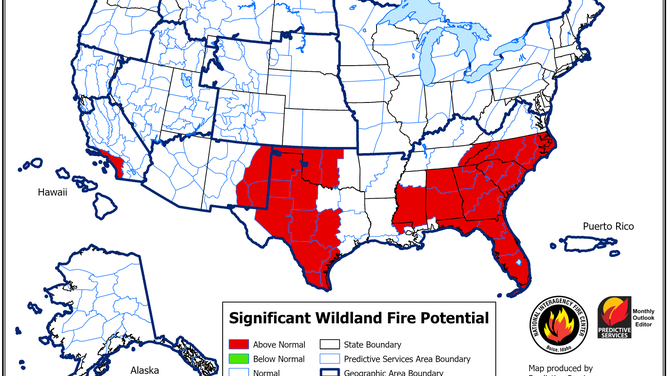
For a significant portion of the year, Southern California is predicted to have a higher risk of wildfires due to the combination of an escalating drought and Santa Ana winds, which can result in more dangerous conflagrations.
According to forecasts issued by the National Interagency Fire Center, there will be more fires throughout the southern tier of the nation, including Florida, the Carolinas, and the Desert Southwest, at least until May.
Although there hasn’t been much fire activity nationwide in the first few weeks of 2025, recent firestorms have been concentrated in southern regions of the Golden State.
California Drought Raises Wildfire Risk
The NIFC reports that drought conditions have worsened to moderate to even extreme levels in several areas of the Golden State since they have received less than 25% of their usual rainfall.During this forecast period, fuels are probably going to be drier than usual,” the agency said.
It’s crucial to remember that since dry winters produce less grass, the fuel load is probably going to be lower in the late winter and early spring.
Because of the drier-than-normal fuel prediction, the South Coast PSA is likely to have above-normal severe fire potential.”
La Niña May Worsen Southern Drought
Since most of the storm activity is located far to the north of places like Southern California, Florida, and Georgia, springtime rainfall in the region is usually difficult to come by during periods of La Niña, which is currently in control.
Fortunately, weather patterns may reverse to more than a La Nada because scientists predict that the La Niña episode will be modest.
Wildfires are also more likely to occur throughout a large area of the Southeast, from southern Florida to western North Carolina.
In addition to the threat posed by dead trees and dry brush left over from hurricanes like Helene and Milton, several villages in this region suffer from a precipitation deficit of six to twelve inches.
From parts of the Lower Mississippi Valley through the Southeast, the mix of fuels affected by drought, beetles, and hurricanes will continue to be a worry, according to NIFC researchers. “Earlier in January, parts of southeastern Georgia already reported increased wildfires .”
Dry Weather Fuels Rising Wildfire Threat
Firefighters had to work for several days to completely contain the fires, which resulted in temporary evacuations and the destruction of multiple outbuildings.
Some of the wildfires were caused by power lines that burned dry vegetation nearby, according to firefighters.
Because of the broader La Niña pattern that is in control, persistent above-normal temperatures with below-average precipitation are predicted to persist at least until May.
The fire season in the area usually lasts from late spring to early summer, but major events can cause it to last longer.