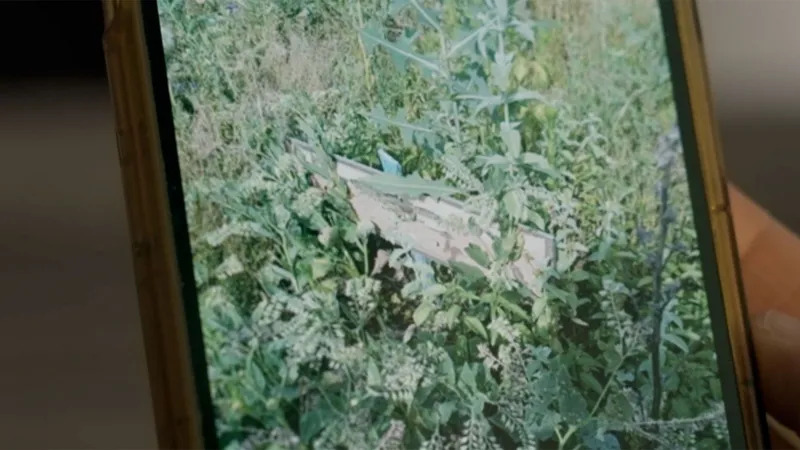
I’m sitting on my balcony in Kyiv, gazing at a picture of a garden in the eastern Ukrainian hamlet where I grew up. Two wooden stakes are buried in the earth, and the area is covered with dense grass. I’m shivering in spite of the nice sunshine.
According to the woman who brought me the picture, my grandparents’ graves are marked with stakes because they were slain when the Ukrainian-Russian front line arrived in our little town. My father, Serezha, is buried in a greenhouse at a nearby garden in the community.
Quick Facts
| Detail | Information |
|---|---|
| What happened | Three members of a Ukrainian family died during heavy shelling and drone strikes in their village. |
| Where | Dachne village, Donetsk region (Donbas), eastern Ukraine. |
| When | January 2025 (Russian forces publicly announced the capture of Dachne on February 14, 2025). |
| Who is involved | Journalist Anastasiya Gribanova, her father Serezha, her grandparents, her sister Sasha, and surviving neighbors. |
| Current status | Dachne remains under Russian control, preventing independent on-the-ground verification. |
| Why it matters | The case highlights the severe human toll on civilians and how war divides families across political lines. |
Torn Between Mother and Homeland
My mother sent me a heartbreaking text message in February of last year when I was covering the Russia-Ukraine war for the World Service. Serezha, Grandad, and Granny are no longer with us. There’s nobody left now,” it stated.
In addition to the fact that I had lost three cherished family members, my mother held Ukraine—the nation where I was born and spent the most of my life—responsible for their passing.
Mom was born in Siberia. She has backed Russia throughout the fight since Moscow began its full-scale invasion of Ukraine in February 2022.
In the Donbas region, a primarily Russian-speaking area of eastern Ukraine where my village, Dachne, is situated, supporting Moscow is not all that uncommon.
Many of those who remained backed Moscow over Kyiv when pro-Russian troops took control of a sizable portion of the Donbas in 2014; this opinion was solidified by exposure to Russian state television.
Nearly 80% of Donetsk, the region of the Donbas where my community is located, is currently under Russian occupation. Since Russia’s full-scale invasion over five years ago, entire villages and cities have been destroyed.
Sisters Reunited in Shared Grief
My sister Sasha, who was residing in Moscow with her small family when the war started, and I had already had a falling out. She cut her off because she wouldn’t pick sides.
However, Sasha suddenly texted me early this year, around the first anniversary of dad’s passing. We began texting each other about our early years and how things used to be. I became aware that I was no longer upset with her. Like me, she was mourning and missing her father.
She was really encouraging when I told her that I wanted to do a documentary on my father.
Tracing Father’s Final Hours Remotely
Dachne has been in Moscow’s hands ever since Russia made the seizure public on February 14.
I was therefore unable to make the trip there in person. I started attempting to get in touch with the neighbors of my family.
I discovered the number of a man I’ll name Misha in a Dachne village message conversation. He was with my father on the day he passed away, I was informed.
Misha informed me that on January 26, he checked on my father and discovered he was hurt.
Final Hours Under Drone Skies
We do know that Russian drones were continuously attacking the area at the time, but it is hard to determine which side was using the drone that murdered my father.
I inquired about the severity of the wound. “He [Serezha] claimed it wasn’t,” Misha recalled, adding that he had discovered my father dead when he had gone back to see how he was doing a few hours later.
Misha said that they had buried him in the greenhouse with the assistance of two other locals.
Returning to a Shattered Street
On the eastern side of Dachne, their home had been demolished. My neighbors informed me that they had fled to a different house on the same block.
Eventually, I came upon a woman I’ll call Lina, who lived close by and was, as far as I know, the last person to see my grandparents alive.
Although she was unable to remember the exact day, she was aware that it fell within the second part of January.
“The Russians were fully advancing at this point, and the village’s edges were being shelled,” she stated. Subsequently, the Ukrainian forces relocated from the village’s outside to its center.