
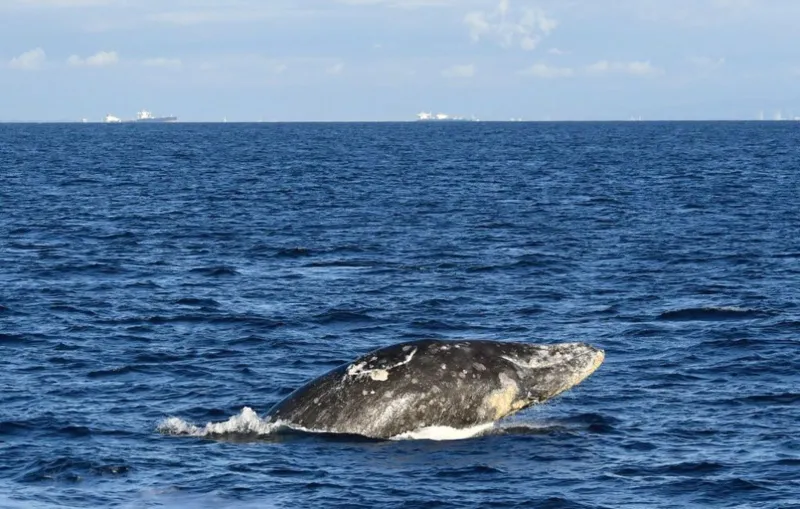
The young gray whale died in Washington after swimming 20 miles upstream along the Willapa River. Researchers believe that the young gray whale may have struggled to find food on its migration.
Whales’ Unusual Journey in the Inland
Locals nicknamed the whale “Willapa Willy”. It was first seen in last week’s river fork. This area is located about 145 mile southwest of Seattle.
Experts from Cascadia research collective observed at the time that the whale appeared thin, but did not show any visible injuries. The whale appeared to behave normally and this gave us hope that it would return to the sea on its own. It did not.
Likely Cause: Hunger During Migration
John Calambokidis is a marine biologist who says that gray whales travel long distances each spring along the Pacific Coast. The gray whales travel to Arctic feeding grounds mainly using stored energy.
Some whales will search for alternate feeding grounds when food becomes scarce. This is what experts believe was the main reason why the young whale entered and stranded in the river.
The Declining Food Supply is a Growing Problem
Gray whales have been facing reduced food supply in recent years in areas like the Bering Sea and Chukchi Seas. It has led to malnutrition, unusual behaviors and straying from migration routes.
NOAA Fisheries data shows the population of gray whales will drop to 13,000 by early 2025. It is the lowest since the 1970s.
Another Recent Whale Death Raises Alarm
This incident is not an isolated one. In April two gray whales, both adults, were discovered dead in Ocean Shores. The animals had both been severely underweight. The head injury of one animal was consistent with being struck by a ship.
The increasing dangers whales are exposed to during their migration is highlighted by these cases. Aside from starvation, other threats include collisions with vessels and becoming entangled in fishing gear.
Gray Whales
The west coast of North America is home to many gray whales. The whales are popular for ecotourism and whale-watching.
Gray whales can reach up to 15 metres in length, and weight around 40,000 kg. They are usually solitary and social relationships can be long lasting.