
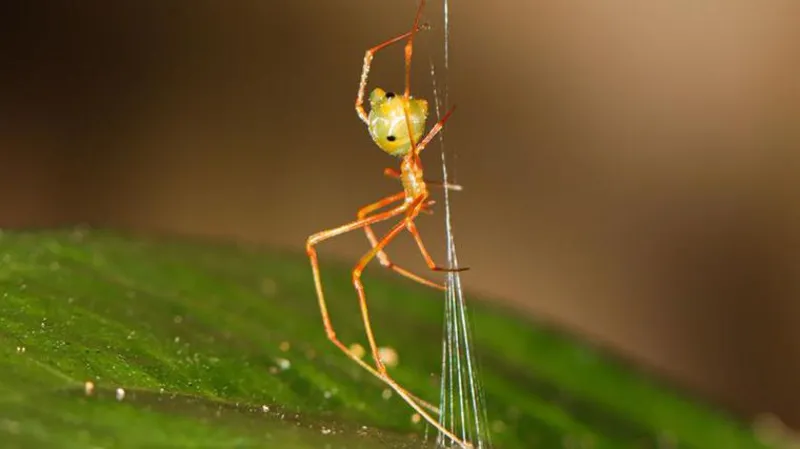
Unique spider found in remote rainforest
Scientists in northern Australia have identified a new spider species that uses a spring like silk trap to hunt prey. The discovery was made in the tropical rainforests of northern Queensland, where researchers observed unusual hunting behavior at night.
The spider has not yet received an official scientific name, but researchers call it the “ballista” spider because of its catapult style hunting mechanism.
How the spring trap works
The spider builds a cone shaped structure using strong silk threads. It anchors the structure to leaves, branches, or the forest floor and carefully tensions the web over several hours.
Once the trap is ready, the spider stays hidden above the structure and waits. When a green tree ant touches the silk, the structure snaps back with extreme force and launches the ant upward into a larger web.
Researchers recorded the acceleration as extremely powerful, far beyond what fighter pilots experience during high speed flight.
A predator focused on one specific prey
What makes this spider unusual is its extreme specialization. It appears to target only one ant species, the green tree ant, even when other ants are nearby.
Scientists believe the spider may use chemical signals to attract or provoke these ants into triggering the trap.
This kind of prey specific hunting strategy has not been documented before in spiders.
Built to avoid dangerous prey
Green tree ants are aggressive and can defend themselves quickly in large numbers. They also have strong chemical defenses and can sting, making them risky prey for most predators.
Researchers suggest the ballista spider evolved this high speed trapping method to safely isolate and capture individual ants without direct contact.
Observations from the field
The research team from Macquarie University spent multiple nights studying the spider using high speed and infrared cameras. They found that the spider only becomes active after sunset and carefully prepares its trap each night.
After triggering, the trapped ants are pulled into the upper web where the spider can safely feed.
Scientific significance of the discovery
Experts say this is one of the most specialized hunting systems ever seen in spiders. It is also one of the few known cases where a web mechanism is triggered directly by the prey rather than the predator.
The spider belongs to the genus Propostira and is still under further scientific study.