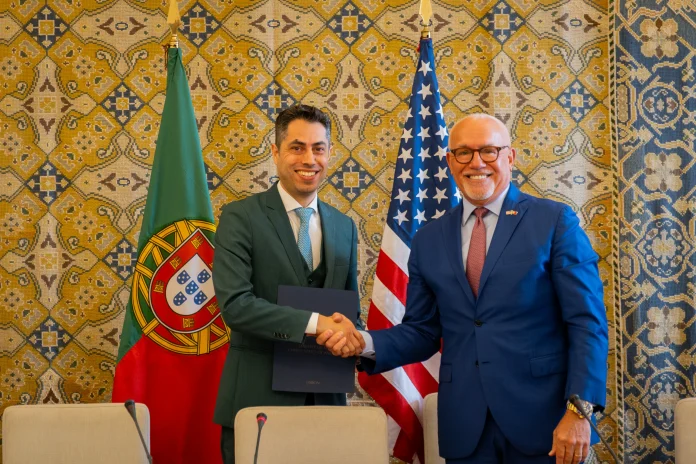
Portugal joins the Artemis Accords.
Portugal has joined global space exploration efforts by signing the Artemis Accords. The agreement commits countries to responsible, peaceful, and cooperative activity beyond Earth.
Portugal’s Secretary of State for Science and Innovation, Helena Canhão, signed the accords during a ceremony in Lisbon. The event took place alongside a semi annual US Portugal government cooperation meeting.
With this move, Portugal becomes the 60th country to endorse the Artemis Accords. As a result, it strengthens its role in future lunar, Martian, and deep space missions.
Portugal highlights vision for sustainable space exploration
Following the signing, Hugo Costa, Executive Director of the Portuguese Space Agency, stressed the importance of the moment. He said 2026 will mark humanity’s return to the Moon and the start of a new phase in space exploration.
He compared this new era to Portugal’s historic age of exploration, referencing Ferdinand Magellan’s global voyage. According to Costa, Portugal approaches space activity with care and responsibility. Therefore, the country is proud to contribute to the peaceful and sustainable use of space for all.
How the Artemis Accords began
NASA and the US Department of State launched the Artemis Accords in 2020. At that time, seven countries joined as founding members.
The initiative responded to rising interest in lunar missions from governments and private companies. As space activity increased, the need for shared rules became more urgent.
Since then, more countries have joined. Consequently, the accords have grown into a global framework for civil space cooperation.
Core principles of the Artemis Accords
The Artemis Accords set out practical guidelines for space exploration. These principles aim to improve safety, transparency, and coordination.
First, countries agree to explore space for peaceful purposes and share information openly. In addition, they commit to making their systems compatible to support joint missions.
Signatories also pledge to assist astronauts in emergencies. They must register space objects to reduce interference and confusion. Moreover, they agree to protect historic sites and artifacts in space.
Resource use on the Moon, Mars, and asteroids must follow international law. At the same time, nations may establish temporary safety zones to avoid operational conflicts. Finally, all members plan for responsible spacecraft disposal to limit orbital debris.
Portugal’s role in global space cooperation
By joining the Artemis Accords, Portugal aligns its space policies with international standards. This step supports scientific data sharing and joint missions with other nations.
The Lisbon ceremony highlights Portugal’s commitment to global space governance. It also shows the country’s intention to take part in long-term exploration efforts responsibly.
Growing global support for the Artemis Accords
Since their launch, the Artemis Accords have expanded from eight founding nations to 60 signatories. More countries are expected to join in the future.
This growth reflects a shared goal. Countries want transparent, cooperative, and peaceful space exploration. NASA and its partners view the accords as a foundation for strong international relations and shared scientific progress.
Portugal’s decision to sign the Artemis Accords marks another step toward a coordinated and sustainable approach to exploring the Moon, Mars, and beyond.